Tanto si se trata de sustituir juntas desgastadas como de instalar válvulas nuevas,determinar con precisión tamaño de la brida En el sector de las tuberías industriales, incluso unos pocos milímetros de error pueden provocar fallos catastróficos. bridas de acero inoxidable.
La importancia de medir con precisión
Antes de empezar, debe saber que el tamaño de una brida no sólo se refiere al diámetro exterior, sino también a una serie de dimensiones específicas que deben ajustarse a normas internacionales como las siguientes ASME B16.5 o EN 1092-1.Si calcula mal el tamaño, los orificios de los tornillos no se alinearán y, en consecuencia, la junta no se asentará correctamente, lo que provocará una distribución desigual de la presión y, finalmente, el fallo de la junta.
Qué hacemos
- Plato
- Hoja
- Piezas forjadas
- Barra redonda
- Brida
- Tuberías
- Accesorios
- Personalizado
Más información
Correlación entre el tamaño de la brida y la clase de presión
Por ejemplo, una brida de clase 150 de 2 pulgadas tiene un círculo de pernos diferente al de una brida de clase 600 de 2 pulgadas.
A medida que aumenta la presión nominal,la brida se hace más gruesa para soportar una mayor tensión interna.Además,los orificios de los tornillos a menudo se hacen más grandes o más numerosos para proporcionar una mayor fuerza de sujeción.En consecuencia,si sólo mide el diámetro interior,es posible que pida un componente que no se ajuste a sus accesorios de tubería de acero inoxidable existentes.Verifique siempre la clasificación “Clase” o “PN” antes de finalizar sus mediciones.
Herramientas esenciales para medir el tamaño de las bridas
- Calibres Vernier:
Ideal para medir espesores y diámetros pequeños. - Calibre exterior grande:
Necesario para medir el diámetro exterior total de bridas grandes. - Medidor de agujeros para pernos:
Ayuda a determinar el diámetro exacto de los orificios. - Tabla de medidas:
Sirve para cotejar sus resultados con las tablas de tallas estándar.
Guía paso a paso para medir su brida
Para encontrar el tamaño de brida correcto, siga esta secuencia específica.Registre siempre sus medidas tanto en milímetros como en pulgadas para evitar errores de conversión.
Medir el diámetro exterior (DE)
Comience midiendo la distancia a lo largo de toda la cara de la brida. Coloque los calibradores en los puntos más anchos del círculo exterior. Esta medición ayuda a reducir la categoría de tamaño potencial, pero no define el índice de presión.
Determinar el diámetro del círculo de pernos (BCD)
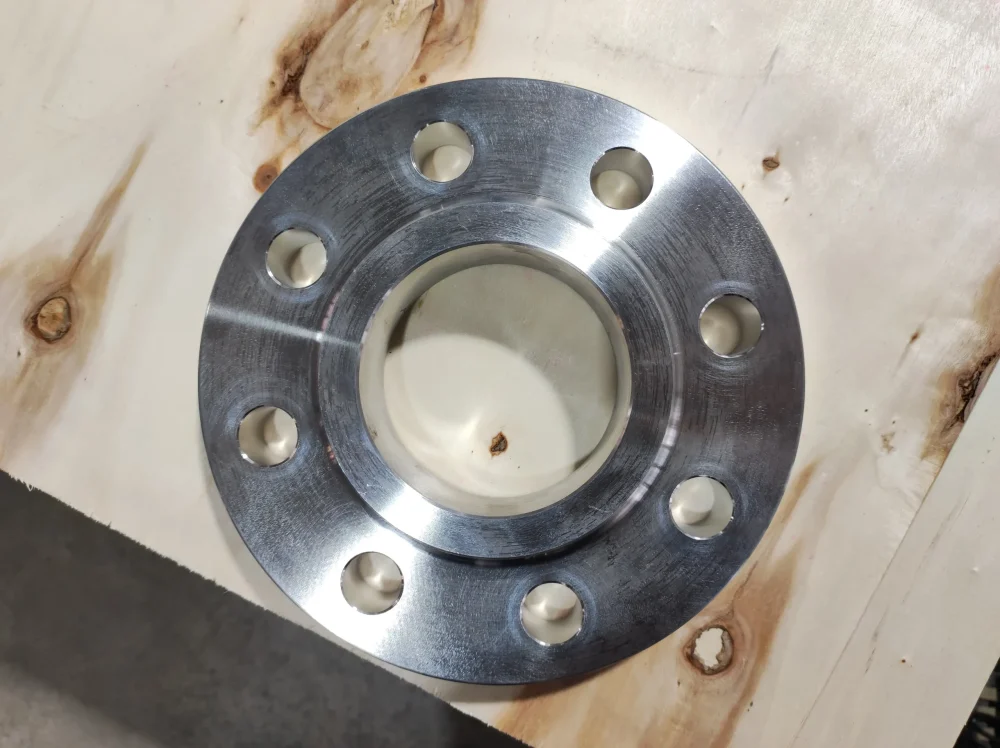
Mida desde el centro de un orificio del tornillo hasta el centro del orificio opuesto. Si no puede llegar al centro, mida desde el borde interior de un orificio hasta el borde exterior del orificio opuesto.
Contar el número de agujeros para pernos
Las bridas estándar suelen tener orificios en múltiplos de cuatro (4, 8, 12, 16, etc.). La combinación de BCD y el número de orificios suele revelar la clase de presión (por ejemplo, Clase 150 frente a Clase 300).
Medir el diámetro interior (ID)
El diámetro interior corresponde al diámetro interior de la brida, que debe coincidir con el tamaño nominal del tubo de acero inoxidable que esté utilizando.
Comprobar el grosor
Mida el grosor de la brida en el borde. Las bridas más gruesas suelen indicar una presión nominal más alta.
Verificación profesional: Lectura de marcas de brida
Los expertos no confían únicamente en los calibradores para determinar las dimensiones de las bridas.Cada brida de acero inoxidable de primera calidad presenta marcas grabadas en su borde exterior.
- Tamaño:
Busque una marca como “2” o “DN50”.” - Valoración:
Verá “150#”, “CL150” o “PN16”.” - Material:
A menudo muestra el grado, como “316L”.” - Estándar:
Busca códigos como “B16.5” o “EN1092-1”.”
Tabla de referencia de tamaños de bridas (ASME B16.5 Clase 150)
| Tamaño nominal de la tubería (NPS) | Diámetro exterior (OD) | Diámetro del círculo de pernos (BCD) | Número de orificios | Diámetro del orificio |
|---|---|---|---|---|
| 1/2 pulgada | 3,50″ (89 mm) | 2,38″ (60 mm) | 4 | 0,62″ (16 mm) |
| 1″ | 4,25″ (108 mm) | 3,12″ (79 mm) | ||
| 2″ | 6,00″ (152 mm) | 4,75″ (121 mm) | 0,75″ (19 mm) | |
| 4″ | 9,00″ (229 mm) | 7,50″ (190 mm) | 8 | |
| 6″ | 11,00″ (279 mm) | 9,50″ (241 mm) | 0,88″ (22 mm) |
Conversión internacional: NPS vs. DN
Si en su proyecto intervienen equipos de distintas regiones,es posible que se encuentre con diferentes sistemas de dimensionamiento.En Estados Unidos se utiliza el NPS (Nominal Pipe Size),mientras que en Europa se emplea el DN (Diámetro Nominal).
| NPS (Imperial) | DN (sistema métrico) | ¿Coincidencia de medidas? |
|---|---|---|
| 2″ | DN50 | Casi idénticos; compruebe la separación de los orificios |
| 4″ | DN100 | Punto de cruce común |
| 8″ | DN200 | Las principales diferencias en los patrones de tornillos comienzan |
Identificación del tipo de cara de brida
La forma de la cara de la brida también influye en la forma de medir el tamaño de la brida: debe identificar si la brida es una “cara plana” (FF), una ”cara elevada” (RF) o una “junta anular” (RTJ).
- Cara levantada (RF):
Estos tienen una pequeña sección elevada alrededor del orificio, por lo que debe medir el diámetro de esta sección elevada por separado. - Junta tipo anillo (RTJ):
Debe medir la anchura y la profundidad de la ranura para seleccionar la junta anular metálica correcta.
Resolución de errores de medición
Si el tamaño de brida medido no coincide con ninguna tabla estándar, tenga en cuenta las siguientes posibilidades: en primer lugar, compruebe si la brida es métrica (DIN/EN) en lugar de imperial (ASME). Las bridas europeas utilizan distancias entre orificios y diámetros diferentes; en segundo lugar, inspeccione la brida en busca de una capa o revestimiento pasivo que pueda añadir un ligero grosor; por último, asegúrese de que la brida no esté doblada.
| Error potencial | Síntoma | Solución |
|---|---|---|
| Sistema métrico frente al imperial | BCD está fuera por unos pocos milímetros | Cambiar a una carta de referencia EN 1092-1 |
| Cara deformada | El OD varía en diferentes puntos | Inspeccionar la brida en busca de daños mecánicos |
| Interferencia de residuos | La medida del ID parece demasiado pequeña | Limpiar el orificio de cualquier cascarilla o escoria. |
| Clase de presión incorrecta | OD es correcto pero BCD es incorrecto | Compruebe si se trata de una brida de clase 300 o 600 |
Contacto
Póngase en contacto con nosotros
- RM901 No.22 Tangjiaqiao Road Wenzhou China
- +86 577 8551 1171
- [email protected]
- https://www.kaysuns.com/
Encuéntranos