Table of Contents
Kaysuns’ customers sometimes ask us which alloy pipes can permanently withstand the harsh conditions of seawater.If you try to use carbon steel,the high concentration of corrosive chloride ions in seawater will corrode your pipes almost instantly.You must use extremely durable marine-grade alloy pipes.
Why Do Standard Alloy Pipes Fail in Seawater?
Chlorides in seawater can quickly penetrate the natural microscopic protective oxide layer on metal surfaces.Once this protective layer is compromised,common metal pipes—such as 304 stainless steel pipes—will corrode rapidly from the inside out.
Not only that,but microorganisms and barnacles in seawater that attach to metal surfaces can accelerate this dangerous corrosion process.To prevent this corrosion from occurring,contact us immediately to upgrade to seawater-grade and high-alloy pipes.
Marine Corrosion Types and Triggers
| Corrosion Type | Primary Cause in Seawater | Danger Level to Piping |
|---|---|---|
| Pitting Corrosion | High chloride ion concentration | Extremely High |
| Crevice Corrosion | Stagnant water under tight flanges | Very High |
| Microbiologically Influenced | Marine bacteria and algae growth | High |
| Galvanic Corrosion | Mixing different metals underwater | Moderate to High |
What We Do
- Plate
- Sheet
- Forgings
- Round Bar
- Flange
- Pipes
- Fittings
- Customized
Contact Us For More Information
Top Alloy Pipes for Marine Environments
The top-tier alloy pipes suitable for marine environments primarily include copper-nickel alloys,titanium,high-nickel alloys,and reinforced stainless steel pipes.The main grades include 904L stainless steel, CuNi 90/10 and CuNi 70/30, Super Duplex 2507, Inconel 625, etc.As a professional manufacturer of stainless steel pipes,Kaysuns offers these high-quality products and is capable of providing matching pipe fittings, flanges, valves, and more.
Copper-Nickel Alloy Pipes: The Traditional Marine Solution
90/10 Copper-Nickel (UNS C70600)
It offers an excellent balance of cost,workability,and corrosion resistance,making it the most widely used alloy grade in marine applications.It exhibits extremely high resistance to uniform corrosion and excellent durability against chloride-induced stress corrosion cracking in untreated seawater.
70/30 Copper-Nickel (UNS C70700)
Designed specifically for high-speed fluid systems,extreme turbulence,and high-temperature environments,this high-quality alloy is ideal for naval combat vessels,high-pressure seawater pipelines,and demanding heat exchanger applications.
Why Copper-Nickel Performs Excellently in Seawater?
When copper-nickel alloys are exposed to oxygen-containing seawater,a stable and strongly adherent surface film of cuprous oxide rapidly forms.This ultra-thin passivation layer effectively protects the underlying metal from chemical corrosion,significantly reduces the rate of uniform corrosion,and shields pipelines from localized pitting corrosion in harsh marine environments.
The continuous,controlled release of copper ions creates a surface that is inhospitable to marine life.This natural mechanism prevents large organisms such as barnacles,algae,and mussels from attaching to the inner walls,thereby ensuring optimal fluid flow rates,reducing maintenance downtime,and maximizing the thermal efficiency of the cooling system.
As a professional and reliable manufacturer of stainless steel pipes in China,Kaysuns can not only help you avoid most mistakes when purchasing stainless steel pipes,but we also offer one-stop piping system services to eliminate all purchasing hurdles for you.Feel free to contact us at any time for a free and quick quote.
Contact Us For More Information
Titanium Alloy Pipe Grades for Marine Environments
Grade 2 (Commercially Pure)
Grade 2 titanium is the workhorse of industrial applications in marine systems,offering a combination of moderate strength,high ductility,and excellent weldability.It is widely used in low-pressure seawater pipelines,plate heat exchangers,and coastal desalination plants.
Grade 5 (Ti-6Al-4V Alloy)
As an alpha-beta alloy containing 6% aluminum and 4% vanadium,Grade 5 delivers exceptional tensile strength and fatigue resistance.It is engineered for deep-sea subsea enclosures,high-pressure risers,and offshore structural components that must endure extreme hydrostatic pressures while maintaining critical lightweight structural profiles.
Why Titanium Performs Excellently in Seawater?
When titanium comes into contact with oxygen or moisture,it spontaneously forms an extremely stable and tough passivation layer of titanium dioxide (TiO₂).This layer provides complete protection against localized pitting corrosion,crevice corrosion,and chloride-induced stress cracking at all operating temperatures in marine environments.
Unlike copper alloys,titanium retains its structural integrity even under extreme fluid velocities exceeding 30 meters per second and severe sediment-induced cavitation.Its passivated oxide film is capable of withstanding mechanical wear caused by turbulent,sediment-laden seawater.
High-Nickel Alloy Pipe Grades for Marine Environments
Inconel 625 (UNS N06625)
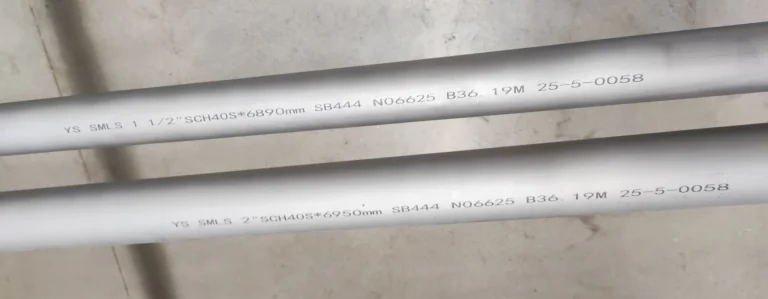
Inconel 625 pipe offers exceptional mechanical strength and fatigue resistance.It is widely recognized as the material of choice for marine components,specialized subsea splash zone piping,and high-temperature exhaust systems operating in harsh offshore environments.
Monel 400 (UNS N04400)
Monel 400 pipe exhibits high toughness and excellent structural integrity in seawater applications;it contains approximately 67% nickel and 30% copper.It is the industry standard for ship splash-zone casings,high-speed pump shafts,propeller shafts,and specialized seawater intake piping systems.
Why High-Nickel Alloys Perform Excellently in Seawater?
Stress corrosion cracking caused by chlorides can rapidly degrade ordinary stainless steel.In contrast,the high nickel content of nickel alloy pipe provides complete resistance to localized pitting corrosion,crevice corrosion,and chemical degradation in stagnant,low-oxygen,or warm tropical seawater environments.
Even under conditions of extremely high fluid velocities,severe turbulence,and sand-laden abrasive cavitation,these materials remain highly resistant to corrosion and destruction.Their exceptional mechanical hardness effectively prevents erosion corrosion and physical wear,thereby ensuring an exceptionally long service life for high-pressure subsea risers,downhole pipelines,and harsh offshore oil and gas production pipelines.
Stainless Steel Pipe Grades for Marine Environments
Super Duplex 2507 (UNS S32750)
Super duplex 2507 pipe has a 50:50 balanced austenitic-ferritic microstructure and is rich in chromium,molybdenum,and nitrogen.With a PREN greater than 40,it is capable of operating year-round in high-pressure subsea oil pipelines and offshore reverse osmosis desalination systems.
6% Moly Austenitic, 254 SMO (UNS S31254)
254 SMO contains high levels of molybdenum and nitrogen.It offers outstanding resistance to localized chloride corrosion while maintaining excellent ductility and weldability,making it an ideal choice for marine scrubbers,slightly saline water pipelines,and coastal chemical processing equipment.
Why Do These Types of Stainless Steel Perform So Well in Seawater?
High concentrations of chromium and molybdenum react rapidly with oxygen to form a highly stable,self-healing chromium oxide passivation layer.This prevents corrosive chloride ions from penetrating the metal surface,thereby effectively preventing localized pitting corrosion and crevice corrosion in marine environments with high oxygen flux.
Unlike standard 316L stainless steel,which rapidly degrades in warm salt water,specialized marine-grade stainless steel is resistant to chloride-induced stress corrosion cracking.Its advanced chemical composition and duplex structure allow it to absorb mechanical loads without developing microcracks,thereby ensuring excellent durability under high-intensity wave cycles and heavy marine operational loads.
Troubleshooting Marine Corrosion
PREN stands for Pitting Resistance Equivalent Number.It measures a metal’s ability to resist aggressive chloride pitting.For safe seawater use,you need a PREN above 40.
No.While 316L resists mild chlorides,warm seawater causes rapid pitting.You must use super duplex alloy pipes for permanent submersion.
High fluid velocity strips the protective oxide layer from copper-nickel.You must keep seawater flow rates below 3.5 meters per second strictly.
No.Titanium forms an instant,unbreakable oxide layer directly underwater.It requires zero protective coatings in harsh seawater environments.
Contact Us
Get In Touch
- RM901 No.22 Tangjiaqiao Road Wenzhou China
- +86 577 8551 1171
- [email protected]
- https://www.kaysuns.com/
Find Us