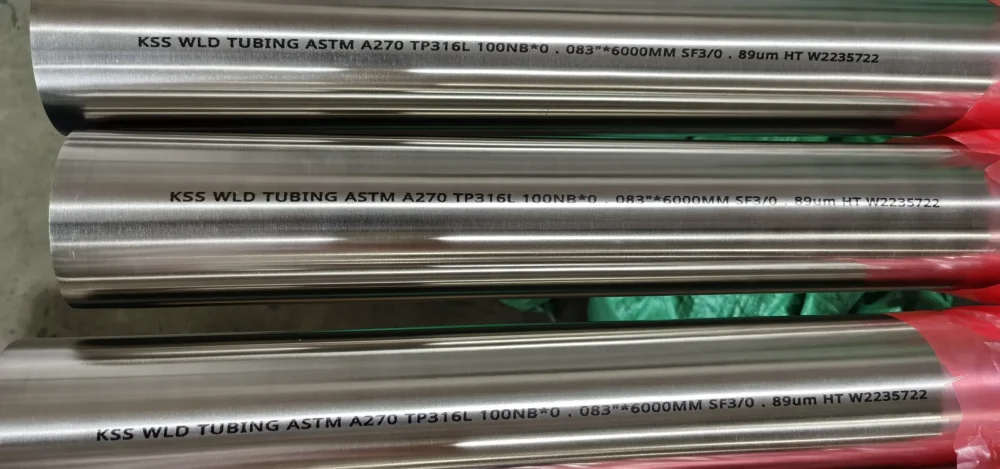
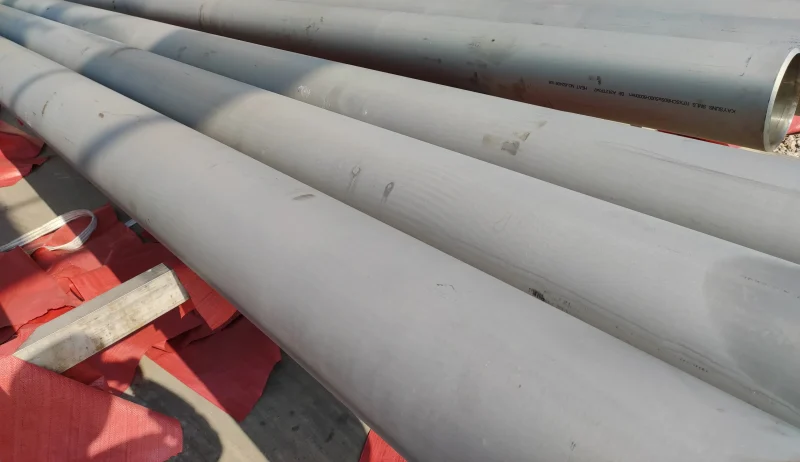
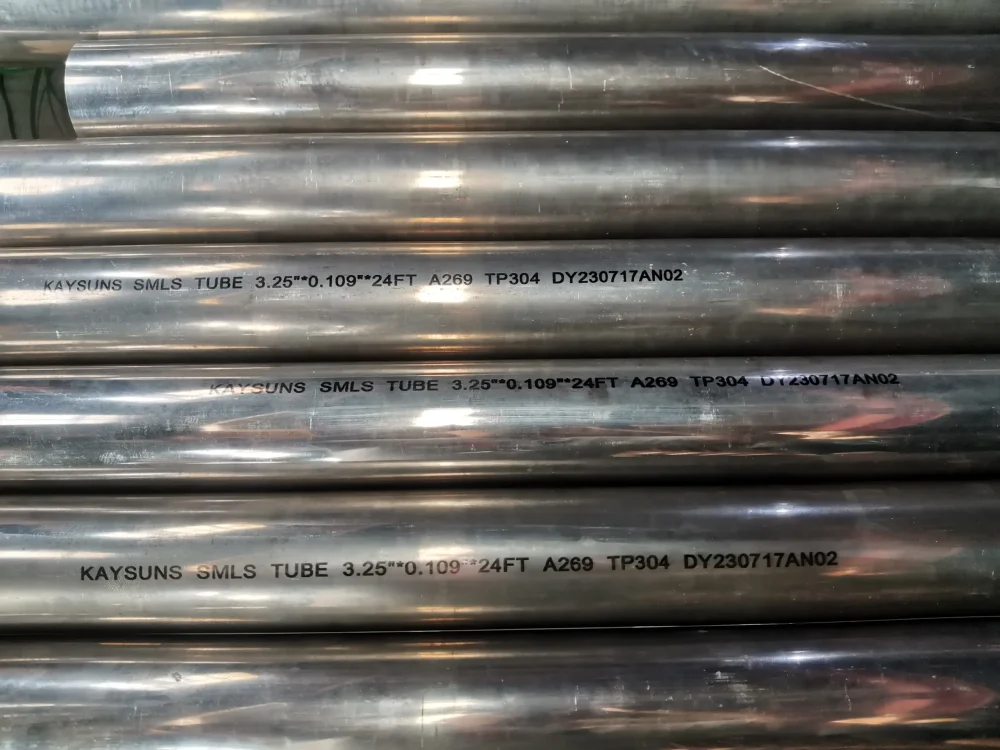
Common Materials for an ASTM A269 Tube
Manufacturing Processes and Sizing Specifications
Standard Outside Diameter Tolerances for ASTM A269 Tube
| Specified OD | OD Tolerance (Imperial) |
OD Tolerance (Metric Equivalent) |
Nominal Wall Thickness Tolerance |
|---|---|---|---|
| Under 1/2” 12.7 mm |
± 0.005 in. | ± 0.13 mm | ± 15% |
| 1/2” to 1-1/2” 12.7 to 38.1 mm |
± 0.005 in. | ± 0.13 mm | ± 10% |
| Over 1-1/2” to 3-1/2” 38.1 to 88.9 mm |
± 0.010 in. | ± 0.25 mm | ± 10% |
| Over 3-1/2” to 5-1/2” 88.9 to 139.7 mm |
± 0.015 in. | ± 0.38 mm | ± 10% |
| Over 5-1/2” to 8” 139.7 to 203.2 mm |
± 0.030 in. | ± 0.76 mm | ± 10% |
Ovality of ASTM A269 Tube
- Standard Wall Thickness (>3% of OD):
For standard tubing,the maximum and minimum diameter measurements at any given cross-section must fall entirely within the standard outside diameter tolerance range specified above.No additional ovality tolerance is provided. - Thin-walled tubes (≤ 3% of OD):
Tubes with wall thicknesses less than or equal to 3% of the outside diameter are subject to natural deformation during heat treatment.For such thin-walled tubes,the permissible ovality range is expanded to twice the standard outside diameter tolerance range.However,the average of the maximum and minimum outside diameter readings must still comply with the primary tolerance.
What We Do
- Plate
- Sheet
- Forgings
- Round Bar
- Flange
- Pipes
- Fittings
- Customized
Contact Us For More Information
Key Mechanical Properties of the ASTM A269 Tube
Maximum Hardness Limits for Common Grades
| Stainless Steel Grade | Brinell HBW, Max | Rockwell, Max | Vickers HV, Max |
|---|---|---|---|
| TP304 / TP304L | 192 HBW | 90 HRB | 200 HV |
| TP316 / TP316L | 192 HBW | 90 HRB | 200 HV |
| TP321 (Stabilized) | 192 HBW | 90 HRB | 200 HV |
| TP347 | 192 HBW | 90 HRB | 200 HV |
| TP317L | 192 HBW | 90 HRB | 200 HV |
| TP201 | 220 HBW | 96 HRB | 230 HV |
| TP201LN | 250 HBW | 100 HRB | 263 HV |
| TPXM-10 | 269 HBW | 25 HRC | 285 HV |
Primary Application Fields Worldwide
Required Testing and Quality Control Standards
ASTM A269 Tube Specification:Quality Control Test Methods
| Test Category | Specific Test Method | Reference Standard Parameter |
Purpose & Acceptance Criteria |
|---|---|---|---|
| Mechanical Destructive |
Hardness Test | ASTM E18 Max 90 HRB 192 HBW |
Ensures the tube is fully solution-annealed and ductile. Exempt for tubes < 1/4" ID or < 0.020" wall. |
| Flaring Test (Seamless) |
ASTM A1016 Tapered mandrel |
Expands the tube end. The material must show no visible cracking or structural tearing. |
|
| Flange Test (Welded) |
ASTM A1016 90° bend flange |
Forms a flat rim at the tube edge. Checks for seam split or heat-affected zone (HAZ) cracking. |
|
| Reverse Flattening (Welded) |
ASTM A1016 180° split & flatten |
Evaluates internal weld root penetration. The flattened weld section must show no signs of separation. |
|
| Nondestructive | Eddy Current Test | ASTM E426 Electromagnetic coils |
Detects subsurface micro-defects,pinholes, or cracks by scanning changes in electrical conductivity. |
| Hydrostatic Test | ASTM A1016 Calculated pressure |
Presses water into the tube to verify mechanical leak tightness. Must hold pressure without drops or sweat. |
|
| Dimensional Checks | Outside Diameter | Caliper Laser micrometer |
Verifies strict exterior dimensions(e.g., ±0.005″ for 1/2″ to 1-1/2″ tubes) for proper fitting connection. |
| Wall Thickness | Ball micrometer Ultrasonic |
Ensures consistency across the lot (typically ±10% for standard sizes, ±15% for < 1/2" OD). |
|
| Metallurgical Chemical |
Chemical Analysis | OES Spectrometry |
Verifies that alloy elements (C, Cr, Ni, Mo, etc.) precisely match the mandatory UNS chemistry limits. |
| Grain Size Exam | ASTM E112 Microstructure |
Evaluates crystalline grain refinement under magnification to confirm proper heat treatment. |
Proper Installation of an ASTM A269 Tube
ASTM A269 Tube Troubleshooting
No,you should never use it for load-bearing structures.This specification targets fluid transport and general service applications only.You should choose ASTM A554 tubes for mechanical structural purposes instead.
ASTM A213 applies specifically to high-heat boiler and heat-exchanger tubes.It requires strict tensile testing continuously.Conversely,ASTM A269 targets general service environments and only mandates hardness testing.
The standard only requires the tubes to be clean and free of scale.You can request special sanitary mirror polishes for food-grade applications separately.
Yes,austenitic stainless steel retains excellent toughness at ultra-low temperatures.Aerospace and medical industries use them safely for liquid nitrogen transport lines.
Contact Us
- RM901 No.22 Tangjiaqiao Road Wenzhou China
- +86 577 8551 1171
- [email protected]
- https://www.kaysuns.com/