Skip to content
Home » AI Data Center Pipes: Grades, Specs & Standards

AI Data Center Pipes: Grades, Specs & Standards

    High-performance AI data center pipes form the critical lifeline of modern liquid-cooled computing infrastructure.Next-generation GPU clusters generate enormous heat loads during the training of large-scale language models, and traditional air conditioning systems are unable to effectively remove this concentrated heat. The only solution is to deliver coolant directly to the server racks via precision stainless steel pipes.

    Why Liquid Cooling Demands Specialized AI Data Center Pipes

    Modern artificial intelligence chips push thermal design power past 1,000 watts per processor. High-density server cabinets now consume 100 kW to 130 kW per rack. Standard chilled-air cooling hits a physical wall around 35 kW per rack. Water and glycol mixtures transfer heat 3,000 times more efficiently than air.
    Hyperscale operators must install direct-to-chip liquid cooling systems.These closed-loop networks require durable AI data center pipes that resist corrosion and bio-fouling.High coolant flow rates also create intense hydraulic pressure inside the distribution network. Stainless steel tubes handle these pressures safely without shedding particles into the fluid stream.

    Table of Contents

    What We Do
    • Plate
    • Sheet
    • Forgings
    • Round Bar
    • Flange
    • Pipes
    • Fittings
    • Customized

    Contact Us For More Information 

    Locations for AI Data Center Pipes in Cooling Loops

    Rack Manifolds and Headers:
    Vertical stainless steel tubes are installed directly inside the server rack. These manifolds distribute the coolant evenly to 36 or 72 individual server blades. Round or square 316L stainless steel tubes are used, with the tube openings laser-drilled and the branch outlets precision-welded.
    CDU Secondary Side (TCS Piping):
    The technical cooling system connects the coolant distribution unit to the server rack. This circuit requires ultra-clean AI data center piping with smooth inner walls. Even the tiniest oxide particles can clog the 50-micrometer microchannels inside the copper GPU cold plate.
    Quick Disconnects (QD) and Blind-Mate Connectors:
    Use leak-free quick-connect fittings to insert the server blades into the rack manifold. These high-precision fittings are machined from cold-drawn 316L stainless steel bar stock and seamless tubing to ensure zero fluid leakage during hot-swap server maintenance.
    Facility Side (FWS) and CDU Primary Loop:
    The facility’s water system transfers heat from the heat exchangers in the atmospheric-pressure unit to the cooling towers. The main circuit uses large-diameter ASTM A312 Schedule 10S or 40S stainless steel piping.

    AI Data Center Pipes VS Alternative Materials

    Before finalizing the data center blueprint, we can evaluate various pipe materials. Although EPDM rubber hoses offer good flexibility, they allow oxygen from the air to permeate into the coolant, accelerating internal corrosion in radiators and cold plates. Copper pipes have high thermal conductivity but are prone to erosion corrosion at high flow rates; furthermore, propylene glycol coolant can leach copper ions, leading to galvanic corrosion.
    In contrast, stainless steel AI data center pipes are virtually immune to aging issues. Stainless steel offers zero oxygen permeability, exceptional burst strength, and a service life of up to 25 years. Stainless steel piping is perfectly compatible with the 316L plate heat exchangers brazed inside standard cooling units and eliminates galvanic corrosion in the secondary cooling circuit.
    MaterialOxygen PermeationErosion LimitCleanliness LevelExpected Lifespan
    316L Stainless SteelZeroUp to 4.5 m/sUltra-High (ASME BPE)Over 25 Years
    Copper TubingZeroUnder 1.8 m/sModerate (Oxide risk)10 to 15 Years
    EPDM Rubber HoseHighUp to 3.0 m/sLow (Particle shedding)3 to 5 Years
    Thermoplastic (PP-R)ModerateUp to 2.5 m/sHigh10 to 15 Years
    Carbon SteelZeroUp to 3.0 m/sVery Low (Severe rust)Not Recommended

    Selecting the Best Alloy Grades for Server Cooling

    Propylene glycol and ethylene glycol solutions decompose into organic acids during prolonged thermal cycling. It is recommended to specify low-carbon austenitic alloys for piping in AI data centers to prevent intergranular weld corrosion.
    316L Stainless Steel Pipe:
    316L is the gold standard for TCS circuits, rack manifolds, and internal piping in CDUs. It resists chloride pitting and acidic ethylene glycol corrosion, and ensures clean-track TIG welding without carbide precipitation.
    304L Stainless Steel Pipe:
    It is recommended to use 304L stainless steel for the water pipes and structural bases of elevated freshwater treatment facilities. Compared to 316L stainless steel, it offers greater corrosion resistance and is less expensive.
    2205 Duplex Stainless Steel Pipe:
    Coastal AI data centers use slightly brackish water or seawater for primary cooling. The yield strength of 2205 duplex stainless steel is twice that of 316L, and it resists chloride stress corrosion cracking.
    Alloy GradeUNS NumberKey Alloying ElementsPrimary Cooling Loop Application
    316LS3160316% Cr, 10% Ni, 2% MoRack manifolds, QDs, CDU secondary TCS loops
    304LS3040318% Cr, 8% NiFacility water system (FWS) primary headers
    2205 DuplexS3220522% Cr, 5% Ni, 3% MoCoastal seawater primary heat rejection loops

    Dimensional Standards and Tolerances for AI Data Center Pipes

    Precision automated orbital welding requires exact outside diameter and wall thickness consistency. If two tube ends have mismatched diameters, the welding arc creates an uneven internal bead.
    Small-diameter instrument and manifold tubing manufactured by Kaysuns complies with ASTM A269, ASTM A270, EN 10216-5, and ASME BPE standards. Larger facility distribution piping complies with ASTM A312 and ASME B36.19M (10S and 40S pipe sizes) standards. Our products maintain an outer diameter tolerance of ±0.10 mm, ensuring leak-free connections with compression fittings and track-welded joints.
    StandardTypical Size RangeOD ToleranceWall TolerancePrimary System Zone
    ASTM A270 / BPEOD 12.7 to 101.6 mm±0.13 to ±0.25 mm±10%TCS secondary loop & manifolds
    ASTM A269OD 6.0 to 76.2 mm±0.13 to ±0.25 mm±10% to ±15%CDU internal lines & sensors
    ASTM A312NPS 1″ to 12″+0.40 to +1.60 mm±12.5%FWS primary chiller loops
    EN 10305-1OD 6.0 to 48.0 mm±0.08 to ±0.15 mm±7.5% to ±10%High-precision QD connectors

    Internal Cleanliness and Surface Finish Requirements

    GPU cold plates contain micro-skived copper fins spaced just 50 to 100 microns apart. Any mill scale, welding slag, or machining oil inside AI data center pipes will block these channels. Blocked channels cause immediate localized overheating and permanent silicon chip failure.
    To prevent contamination, all TCS tubing supplied by Kaysuns undergoes bright annealing or electropolishing. The bright annealing process controls the internal surface roughness to less than 0.8 micrometers (32 microinches). Electropolishing further smooths out internal metal irregularities, resulting in an Ra value below 0.4 micrometers (15 microns). After polishing, the tubing undergoes ultrasonic solvent degreasing, citric acid passivation, and rinsing with high-purity deionized water. Finally, our staff seals both ends of the tubing with cleanroom-grade plastic caps in an ISO Class 6 cleanroom.

    As a professional and reliable manufacturer of stainless steel pipes in China,Kaysuns can not only help you avoid most mistakes when purchasing stainless steel pipes,but we also offer one-stop piping system services to eliminate all purchasing hurdles for you.Feel free to contact us at any time for a free and quick quote.

    Contact Us For More Information 

    Manufacturing Process for High-Purity Cooling Tubes

    Producing defect-free AI data center pipes requires strict metallurgical control from raw billet to final packaging.First, Kaysuns Steel uses a vacuum oxygen decarburization process to melt high-purity 316L raw material in order to remove non-metallic inclusions. Next, the tube diameter is reduced and the metal grain structure is refined through cold drawing and precision cold drawing processes.
    Unlike traditional open-air annealing, the tubes are passed through a continuous bright annealing furnace filled with 100% pure hydrogen. This oxygen-free heat treatment eliminates mechanical stress without forming black oxide scale on the tube walls. Finally, before precision cutting and cleanroom packaging, an automated laser micrometer inspects the tubes for roundness and straightness.

    KAYSUNS Mechanical and Non-Destructive Leak Testing

    Producing defect-free AI data center pipes requires strict metallurgical control from raw billet to final packaging.First, Kaysuns Steel uses a vacuum oxygen decarburization process to melt high-purity 316L raw material in order to remove non-metallic inclusions. Next, the tube diameter is reduced and the metal grain structure is refined through cold drawing and precision cold drawing processes.
    We fully understand that data center operators have zero tolerance for even the slightest leak in their server rooms, which are worth millions of dollars. KAYSUNS enforces a multi-stage verification protocol on all AI data center pipes before they are shipped worldwide.
    • Positive Material Identification (PMI): Handheld X-ray fluorescence spectrometers verify molybdenum and nickel percentages on 100% of tubes.
    • Eddy Current Testing (ASTM E426): Automated sensors scan the entire tube length to detect microscopic pinholes or subsurface seams.
    • Hydrostatic and Pneumatic Testing: Every pipe withstands high-pressure water or dry nitrogen testing without pressure drop.
    • Helium Mass Spectrometer Leak Testing: For prefabricated manifold assemblies, helium testing detects leak rates down to 10⁻⁹ Pa·m³/s.
    • MechanicalDestructive Tests: Lab technicians perform flattening, flaring, reverse bending, and tensile tests on every heat batch per EN 10204 3.1.
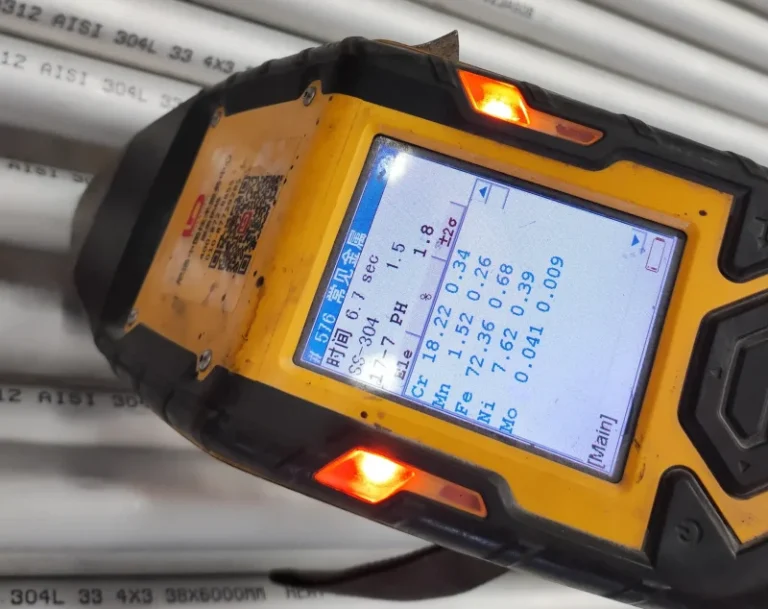
    304L AI Data Center Pipes PMI

    FAQs

    Grade 316L contains added molybdenum, which resists acidic degradation products formed by heated propylene glycol coolants. It also offers superior corrosion defense against biocides and inhibitors in the TCS loop.

    Secondary TCS loops and rack manifolds require an internal surface roughness below 0.8 microns (Bright Annealed). Ultra-high-density GPU systems often specify electropolished tubes with an Ra below 0.4 microns to prevent micro-channel clogging.

    Welders use automated orbital TIG equipment paired with 99.999% pure argon back purging. Maintaining internal oxygen below 20 PPM produces a smooth, silver weld root with zero flaking scale.

    Use seamless cold-drawn tubes (ASTM A269) for high-pressure quick disconnects, tight-radius bent tubes, and small instrumentation lines. High-purity laser-welded and cold-worked tubes (ASTM A270) work excellently for straight rack manifolds and CDU distribution headers.

    Contact Us

    Get In Touch
    Find Us
    logo of Kaysuns

    Welcome to contact us

    Supplying of
    Stainless & Alloy Piping Material

    • Need an offer ?
    • Want to know the dimension / catalog ?
    • Talk about the technical issues ?

    Feel free to contact us, and we will be more than happy to answer all of your questions.

    Get a Free Quote Now

    small_c_popup.png

    Get a free Quote now

    Do you want to learn more? Contact us

    We will reply you in 24 hours. Thank you!