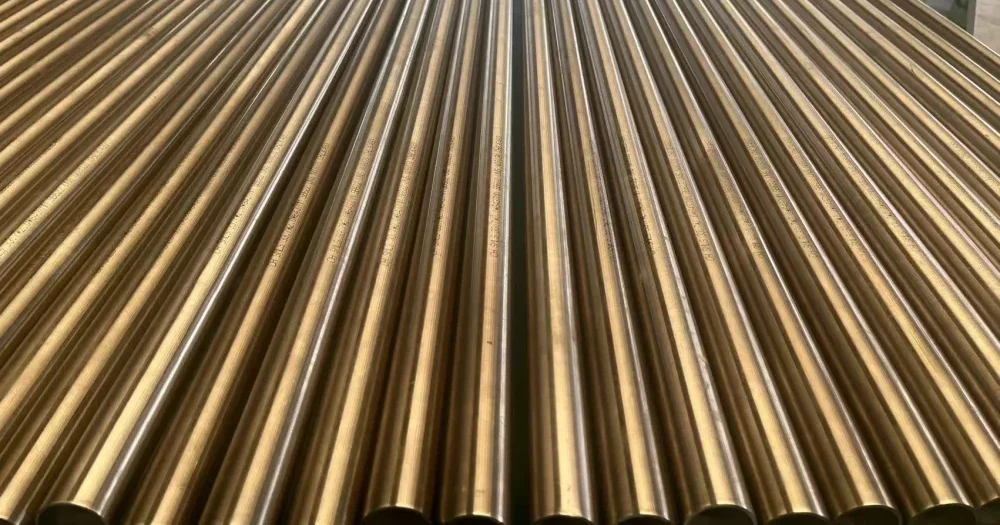
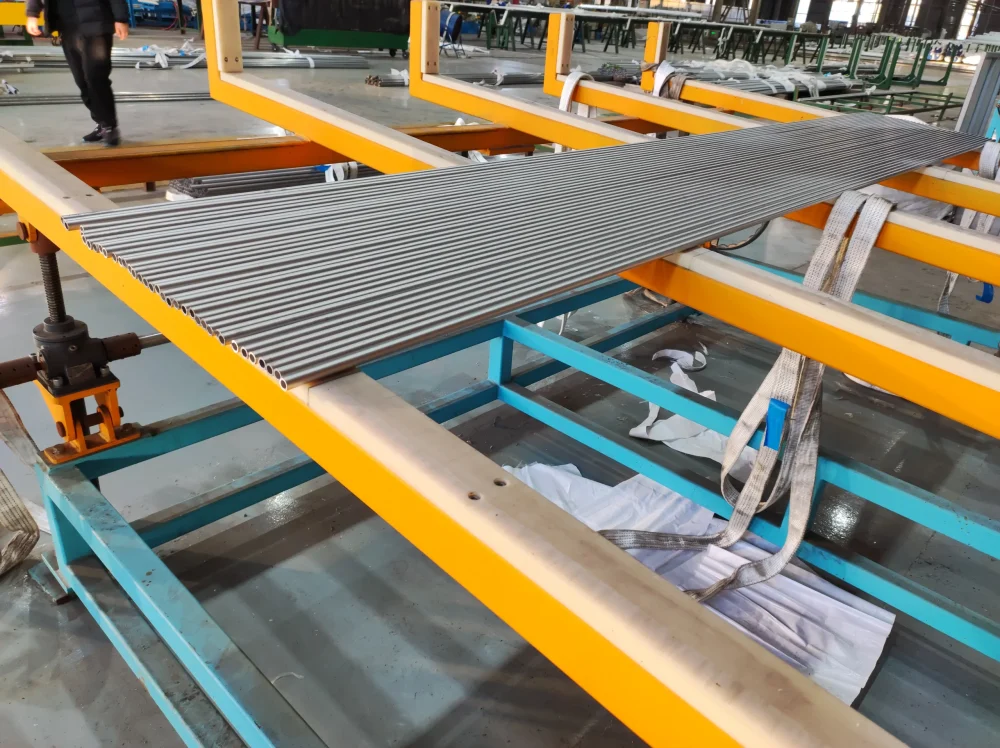
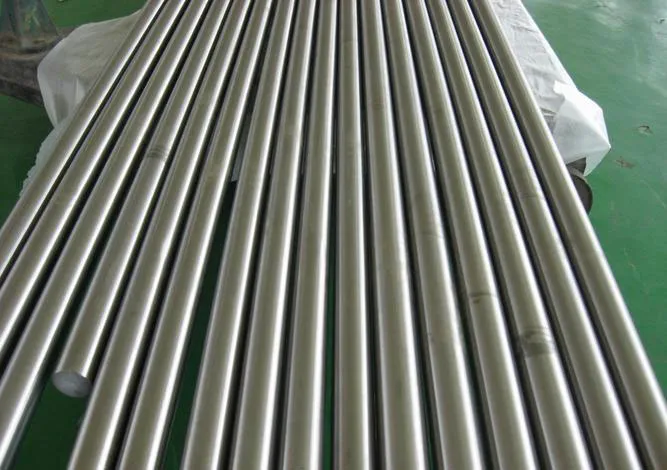
Duplex UNS S32304 Pipe
Duplex UNS S32304 Pipe is an economical “lean” duplex stainless steel pipe (austenitic-ferritic).It contains approximately 23% chromium,4% nickel,and no molybdenum.
Its yield strength is twice that of 304L stainless steel pipe and 316L stainless steel pipe,offering superior resistance to stress corrosion cracking and enhanced corrosion resistance.It serves as an ideal,durable,and economical choice for chemical processing,seawater desalination,and oil/gas applications.
Our Capacity
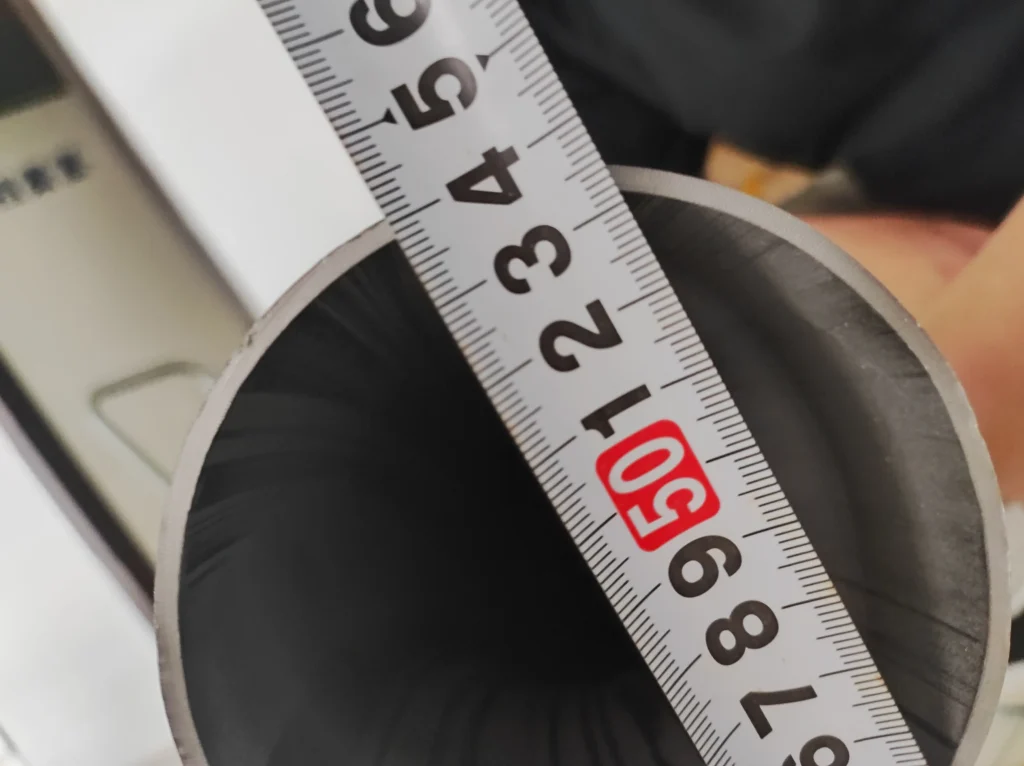
UNS S32304 Equivalent Designations
- Alloy 2304 / SAF 2304
- EN 1.4362 / W.Nr. 1.4362
- JIS SUS 32304
- GB 022Cr23Ni4MoCuN / 02Cr23Ni4N
Have a requirement?
Contact Us For More Information
Chemical Composition of Duplex UNS S32304 Pipe, wt.%
| Cr | Ni | N | Mn | Mo | Cu | C | Si | P | S | Fe |
|---|---|---|---|---|---|---|---|---|---|---|
| 21.5 – 24.5 | 3.0 – 5.5 | 0.05 – 0.20 | 2.50 Max | 0.05 – 0.60 | 0.05 – 0.60 | 0.030 Max | 1.00 Max | 0.040 Max | 0.030 Max | Balance |
Why Must The Carbon Content Be Kept At Such A Low Level?
Low carbon limits prevent carbide precipitation during welding.This ensures the pipeline maintains resistance to intergranular corrosion within the heat-affected zone (HAZ).
What Role Does Nitrogen (N) Play in This Alloy?
- Strengthening:
Significantly increases yield strength. - Pitting Resistance:
Enhances the alloy’s ability to resist localized chloride corrosion. - Phase Equilibrium:
It helps ensure sufficient austenite reform in the weld zone,preventing the steel from becoming excessively “ferritic” and brittle after heating.
Mechanical Properties of Duplex UNS S32304 Pipe
| Tensile Strength | Yield Strength (0.2% Offset) | Elongation | Hardness (Max) |
|---|---|---|---|
| 600 – 850 MPa(87,000 – 123,000 psi) | ≥ 400 MPa(58,000 psi) | ≥ 25% | ≤ 290 HBW |
Does The High Strength Make It Difficult To Bend Or Form?
Yes,it is more challenging than standard stainless steel.Bending and forming require greater force,and the metal exhibits more pronounced springback,meaning it resists deformation and tends to return to its original shape.
Duplex UNS S32304 Physical & Thermal Properties
- Density:7.8 g/cm³ (0.28 lb/in³).
- Melting Range:1440 – 1480°C (2625 – 2700°F).
- Magnetic Permeability:Ferromagnetic.
- Electrical Resistivity:800 nΩ · m.
- Specific Heat:450 J/kg·K(0.107 Btu/lb·°F).
- Thermal Conductivity:17 W/m·K(9.8 Btu/ft·h·°F).
Seamless vs. Welded Duplex UNS S32304 Pipe
Manufacturing Process
- Seamless Pipe:
Produced through hot extrusion or cold drawing,featuring no longitudinal or circumferential welds.Its microstructure is entirely formed from the base metal through heat treatment. - Welded Pipe:
Manufactured by rolling steel coil or plate and joining the edges via TIG,plasma,or laser welding.Post-weld solution annealing is typically required to restore the duplex equilibrium in the weld zone.
Performance Comparison
| Characteristics | Seamless | Welded |
|---|---|---|
| Pressure Resistance | Higher.No weld weak points;weld reduction factors need not be considered in pressure rating (ASME) calculations. | Lower.Due to limitations in weld quality, the design pressure is typically 15% lower than that of seamless pipes. |
| Dimensional Accuracy | Wall thickness uniformity is relatively poor,and the outer diameter tolerance is relatively large. | Superior.Made from cold-rolled steel,it features exceptionally uniform wall thickness and extremely smooth inner and outer surfaces. |
| Corrosion Resistance | More stable.Uniform throughout the entire pipe. | If welds are not properly treated,they may become the starting point for pitting corrosion or stress corrosion cracking. |
| Maximum Dimensions | Due to extruder size limitations,the diameter typically does not exceed 12 to 16 inches. | Pipes of extremely large diameters can be manufactured,even exceeding 48 inches. |
How to Select Between Seamless and Welded Duplex UNS S32304 Pipe
Scenarios for Selecting Seamless Pipe
- Extremely High-pressure Environments
- Demanding Bending / Forming Requirements
- Extremely High Safety Requirements
Scenarios for Selecting Welded Pipe
- Heat Exchangers
- Large-Diameter Water Treatment/Pulp Conveyance
- Applications Requiring Wall Thickness Precision
Applications for Duplex UNS S32304 Pipe
- Desalination
- Pulp & Paper
- Heat Exchangers
- Wastewater Treatment
- Food & Beverage
- Chemical Processing
- Offshore & Marine
- Mining
- FGD System
- Structural Piping
FAQs About Duplex UNS S32304 Pipe
The pitting resistance equivalent number (PREN) for S32304 typically ranges between 24 and 26.
It is possible.While all products must comply with ASTM A790 or EN 1.4362 standards,some manufacturers offer “enhanced 2304” grades (e.g., EDX 2304).These modified products typically increase chromium or nitrogen content to the upper limits of the permissible range to achieve a PREN value of 28 or higher.
EN 1.4362 possesses a yield strength of 400 MPa,approximately twice that of 316L stainless steel (approximately 200–220 MPa).This enables “lightweighting”—the design of thinner systems.
No.Although it performs well at temperatures as low as -50°C (-58°F),it undergoes the ductile-to-brittle transition typical of ferritic structures.For cryogenic applications such as liquefied natural gas (-162°C),austenitic steels like 304L or 316L are required.
The maximum operating temperature is 300°C (572°F).Prolonged exposure above this temperature will cause “475°C embrittlement.” At this point,brittle phases precipitate in the microstructure,causing the pipe to lose toughness and become prone to cracking.
Contact Us
- RM901 No.22 Tangjiaqiao Road Wenzhou China
- +86 577 8551 1171
- [email protected]
- https://www.kaysuns.com/