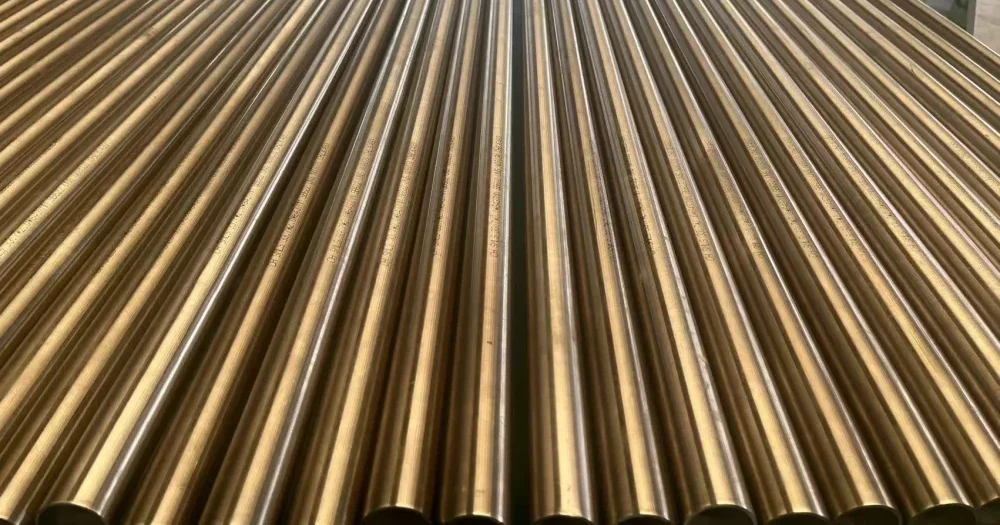
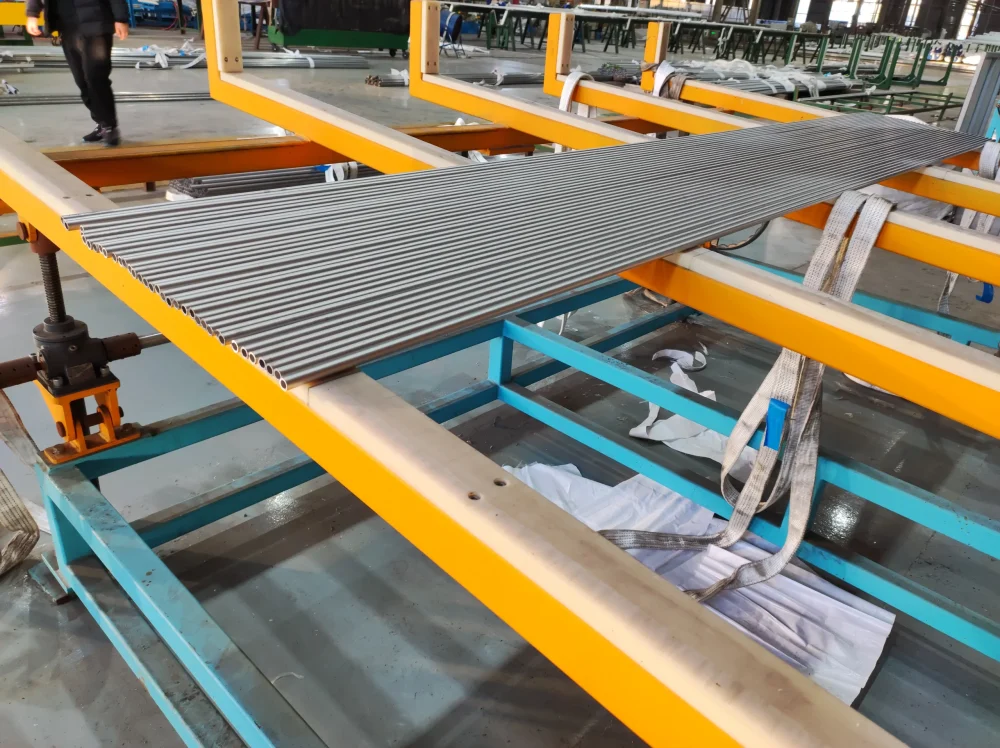
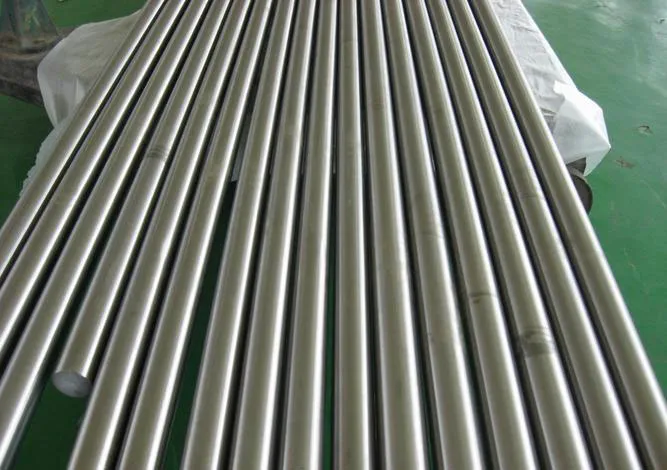
Alloy 52 Bright Bar
Un alloy 52 bright bar is a high-precision,controlled-expansion nickel-iron alloy rod processed via cold-drawing,peeling,or grinding to achieve a scale-free,mirror-like “bright” surface finish.
4J50 is a high-temperature alloy specifically designed for aerospace and electronic applications that complies with the Chinese national standard GB/T 5235.
Propriétés du matériau de base
- Matching Thermal Expansion:
Its standout trait is a steady linear thermal expansion coefficient (9.2–10.0 × 10⁻⁶/K from 20°C to 500°C) that mimics the expansion and contraction rates of soft lead-borosilicate glass and specific ceramics. - Glass-to-Metal Hermeticity:
The bar provides an air-tight bond when melted alongside soft glass.The matching expansion rate prevents the glass from cracking or breaking away from the metal during thermal cycles. - High-Quality “Bright” Finish:
The cold-finished manufacturing route ensures exact diameter roundness,increased hardness,and a flawless exterior profile required for precision CNC Swiss machining.
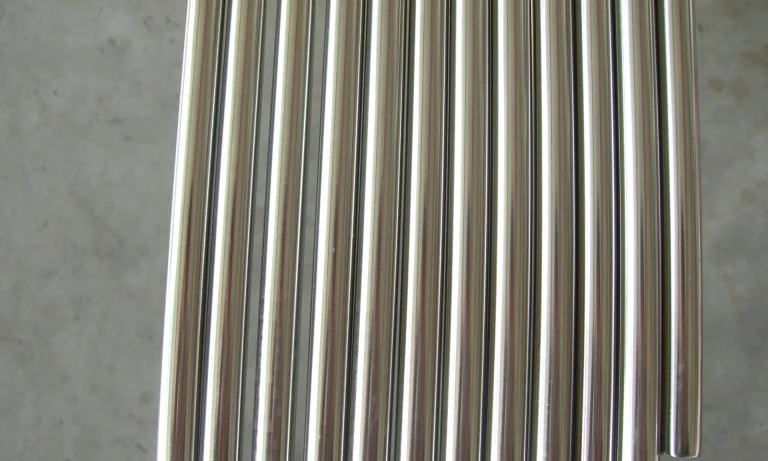
Applications of Alloy 52 Bright Bar
- Reed switches
- Hermetic seals
- Vacuum tubes
- Glass sealing
- Ceramic bonding
- Lead wires
- Sensor housings
- Relay components
- Transistor headers
- Electronic packaging
- Radar units
- X-ray tubes
- Cryogenic frames
- Aircraft instruments
- Industrial lamps
- Diode bases
We offer Alloy 52 (UNS K95050 / ASTM F30 / 4J50) bright bars in diameters ranging from OD 2mm to 201mm,manufactured in compliance with ASTM F30, DIN 17745, and GB/T 5235.
We also supply high-performance alloy tubes et tuyaux (including Hastelloy , Inconel , Incoloy etc.) that are fully compliant with PED 2014/68/EU and CE marks for vacuum engineering and precision applications.
All our production and testing processes are certified to ISO 9001, and all products are delivered with EN 10204 3.1 Mill Test Certificates ensuring optimized glass-to-metal matching thermal expansion coefficients.With over a decade of experience in manufacturing,import,and export,we are your most trusted wholesaler in China.
Chemical Composition of Alloy 52 Bright Bar
The chemical profile of Alloy 52 is highly regulated to ensure precise thermal expansion behavior.Below is the chemical composition percentage by weight, compliant with ASTM F30 and GB/T 5235:
| Élément | Ni | Fe | Mn | Si | C | Cr | P | S | Al |
|---|---|---|---|---|---|---|---|---|---|
| ASTM F30 | 50.0 – 51.5 | Équilibre | ≤ 0.60 | ≤ 0,30 | ≤ 0.05 | ≤ 0.25 | ≤ 0,02 | ≤ 0,02 | ≤ 0.10 |
| GB/T 5235 | 50.0 – 51.5 | Équilibre | ≤ 0,80 | ≤ 0,30 | ≤ 0.05 | ≤ 0.25 | ≤ 0,02 | ≤ 0,02 | ≤ 0.10 |
| Typical Production Target | 50.5 | Équilibre | 0.30 | 0.15 | ≤ 0,02 | ≤ 0.10 | ≤ 0.01 | ≤ 0.005 | ≤ 0.05 |
Le rôle des éléments clés
- Nickel:
This is the precise threshold required to position the alloy’s Curie point to perfectly align its expansion rate with soft lead and soda-lime glasses from 20°C up to 500°C. - Le fer:
Serves as the matrix metal.Variations in the Fe-Ni ratio drastically shift the thermal expansion curve. - Manganese & Silicon:
Added in microscopic,controlled doses to act as deoxidizers during vacuum melting.They improve hot workability and prevent the material from cracking during cold drawing into bright bars.
Critical Control of Impurities
For a “Bright Bar” intended for electronic vacuum tubes and glass hermetic sealing,trace impurities must be kept exceptionally low. High-quality manufacturers use VIM or VAR to remove gases:
- Carbon Danger:
Must be kept under 0.02% in high-end production.Excess carbon reacts during glass sealing to form carbon monoxide/dioxide gas bubbles,causing localized hermetic seal failure. - Sulfur & Phosphorus Danger:
These elements segregate at the grain boundaries,causing “hot shortness” and hindering the smooth,mirror-like execution of the cold-finished bright surface.
How Chemistry Dictates Physical Properties
- Linear Expansion Coefficient (20°C to 500°C):
9.2 × 10⁻⁶/K to 10.0 × 10⁻⁶/K (Perfect match for soft glass/ceramics). - Density: 8.30 g/cm³
- Melting Point: 1430°C
- Curie Temperature:
520°C (Below this temperature,it exhibits low-expansion ferromagnetic traits).
Alloy 52 Bright Bar Standards & Equivalent Designations
| Alloy 52 Strip (Controlled Expansion) | |||||
|---|---|---|---|---|---|
| Norme / Système | Désignation équivalente | Forme du produit | GB (Chine) | GJB (Military) | GOST (Russia) |
| Norme chinoise | 4J50 / 4J52 (Fe-Ni52) | Plaques, feuilles et bandes | GB/T 15018 | GJB 1952A | – |
| Russian / CIS Standard | 52N / 52H (52Н) | Bars & Rods | GB/T 14985 | – | GOST 10994 / 14080 |
| ISO Chemical Name | Ni52 / FeNi52 | Tubes sans soudure | – | – | – |
| UNS System | UNS N14052 / K95050 | Tubes et tuyaux soudés | – | – | – |
| Aviation / Aerospace | ASTM F30 / Werkstoff 2.4475 | Forgings & Rings | – | – | – |
| UK Designation | NILO Alloy 52 / Pernifer 50 | ||||
| Nom commercial générique | Alloy 52, Glass Sealing 52 | ||||
Vous avez un besoin ?
Kaysuns is a professional supplier of Alloy 52 Bright Bar.Please feel free to contact me if you have any requirements.
Contactez-nous pour plus d'informations
Mechanical Properties of Alloy 52 Bright Bar
The mechanical characteristics of Alloy 52 bright bars are highly dependent on the delivery condition—whether the material is in a Stress-Relieved/Annealed state or a Cold-Drawn/Hardened state.
| Propriété mécanique | Annealed / Soft Condition | Cold-Drawn / Bright Bar |
|---|---|---|
| Résistance à la traction | 450 – 550 MPa | 650 – 850 MPa |
| Limite d'élasticité | 240 – 310 MPa | 500 – 700 MPa |
| Elongation at Break | 30% – 45% | 5% – 15% |
| Dureté | 130 – 160 HV / HB | 190 – 240 HV / HB |
| Module d'élasticité | 160 GPa | 165 GPa |
Key Mechanical Attributes
- Excellent Machinability:
In the cold-drawn state,the added structural hardness prevents the alloy from becoming overly gummy during high-speed cutting.It allows precision lathe operations to yield sharp,burr-free threads and components without heavy tool wear. - High Ductility in Annealed State:
When fully annealed,Alloy 52 shows high elongation.This allows the material to undergo severe cold deformation,stamping,and deep drawing if it needs to be shaped into headers,eyelets,or caps before glass fusion. - Impact of Cold Working on Expansion:
Cold drawing alters the grain structure and introduces internal residual stresses.While this improves the mechanical hardness and surface finish of the bright bar,it can slightly shift the thermal expansion coefficient.
Heat Treatment for Mechanical Optimization
- Stress Relief Annealing:
After a bright bar is machined into complex electronic parts,it must be stress-relieved to stabilize its mechanical dimensions.This is typically done at 700°C to 800°C in a protective atmosphere for 1 to 2 hours. - Full Soft Annealing:
To achieve maximum ductility for deep forming,the material is heated to 850°C to 950°C for 30–60 minutes,followed by slow cooling. - Pre-Sealing Degassing:
Heated in a wet hydrogen atmosphere at 1050°C for 30 minutes to clean the surface,lower surface hardness,and eliminate any remaining mechanical stresses before bonding with glass.
Magnetic & Structural Stability
- No Phase Transformation:
Unlike standard carbon steels,Alloy 52 maintains a stable stable Austenitic (γ-phase) face-centered cubic (FCC) crystal structure from ultra-low cryogenic temperatures up to its melting point.This prevents unexpected volume changes or mechanical distortion during extreme temperature shifts. - The Curie Point Transition:
At 520°C,the alloy shifts from ferromagnetic to paramagnetic.Below this temperature,its mechanical elasticity behaves linearly,which is vital for maintaining the physical pressure load of a hermetic seal.
Mechanical Testing Standards
When receiving an EN 10204 3.1 Mill Test Certificate (MTC) for Alloy 52 bright bars,the mechanical testing protocols verify quality through:
- ASTM E8 / E8M:
Standard test methods for tension testing of metallic materials. - ASTM E10 / E92:
Brinell and Vickers hardness validations to ensure structural uniformity along the entire length of the bar.
Our Advantages in Manufacturing Alloy 52 Bright Bar
Fusion par induction sous vide
We control the chemical composition of Alloy 52 by utilizing advanced Vacuum Induction Melting combined with Vacuum Arc Remelting.This dual-vacuum metallurgy removes harmful trace gases like oxygen, nitrogen,and hydrogen,while keeping carbon levels strictly under 0.02%.By minimizing internal inclusions,we prevent carbon monoxide bubbling during high-temperature glass-to-metal fusion,ensuring a flawless,airtight hermetic seal every single time.
Ultra Precise Tolerances
Our cold-finishing facilities employ high-precision drawing,centerless peeling,and automated grinding techniques to process bright bars. We achieve dimensional tolerances down to h7 or h8 levels and maintain a strict straightness standard of less than 0.5mm per meter.This exceptional geometric accuracy and roundness prevent material binding and vibration,making our bars perfectly optimized for high-speed CNC machining centers.
Customized Thermal Expansion
We calibrate the linear thermal expansion coefficient of every batch to perfectly match specific soft glasses and ceramics,ranging from 9.2 to 10.0 × 10⁻⁶/K between 20°C and 500°C.Through precise adjustments of the nickel-iron ratio and dedicated stabilizing heat treatments,we eliminate internal residual stresses.This guarantees that the alloy maintains its dimensional integrity and mechanical properties under volatile thermal cycles.
Certified Traceable Quality
Every single delivery is backed by an ISO 9001 certified quality management framework and a comprehensive EN 10204 3.1 Mill Test Certificate.We conduct thorough destructive and non-destructive evaluations,including ultrasonic flaw detection,eddy current testing, and automated chemical spectrum analysis.This rigorous tracking guarantees complete raw material traceability from the initial melting stage down to the final polished bright bar.
FAQs About Alloy 52 Bright Bar
Alloy 52 contains around 48% iron and will rust if exposed to high humidity,moisture,or corrosive chemicals.Keep the bright bars inside their original waterproof plastic sleeves or anti-rust VCI paper wrappings.Store them in a climate-controlled indoor warehouse with stable temperatures to prevent condensation on the polished surfaces.
Alloy 52 behaves like an austenitic stainless steel during machining and tends to get gummy,gummy chips can quickly gall your tools.Use sulfur-free,heavy-duty chlorinated soluble oils or high-performance synthetic emulsified coolants.Avoid sulfur-bearing cutting fluids because sulfur residue can cause embrittlement and surface defects during the subsequent high-temperature glass-sealing process.
Even a polished bright bar accumulates microscopic oils,fingerprints,and atmospheric tarnish during transit and handling.Pre-seal chemical etching removes these surface contaminants and slightly roughens the exterior.This cleaning allows a uniform,tightly adherent green oxide layer to form when heated,which serves as the molecular bridge that bonds the metal to the molten glass.
Yes,you can weld Alloy 52 to austenitic stainless steels (like 304 or 316) using Gas Tungsten Arc Welding.Use high-nickel filler wires,such as Inconel 82 or ERNiCr-3,to manage the diluting chemistries and prevent thermal cracking.Keep in mind that welding creates a localized heat-affected zone that disrupts the controlled expansion properties,so avoid welding near the critical glass-sealing interface.
Glass cracking is usually caused by an incorrect nickel-iron ratio in the alloy or an improper cooling schedule during production.If the alloy cools down too quickly or its chemical composition shifts slightly out of specification,its contraction rate will deviate from the glass.This discrepancy builds up severe residual tensile stresses at the joint,causing the glass to fracture or pop off.
Yes,heavy cold working converts a very small fraction of the stable austenite matrix into mechanical martensite,which increases the material’s magnetic permeability.If your application demands ultra-low magnetic interference,you must perform a post-machining vacuum anneal above 850°C.This thermal treatment reverts the structure back to a fully stable,predictable austenitic phase and restores its baseline magnetic profile.
Nous contacter
Prendre contact
- RM901 No.22 Tangjiaqiao Road Wenzhou Chine
- +86 577 8551 1171
- [email protected]
- https://www.kaysuns.com/
Trouvez-nous