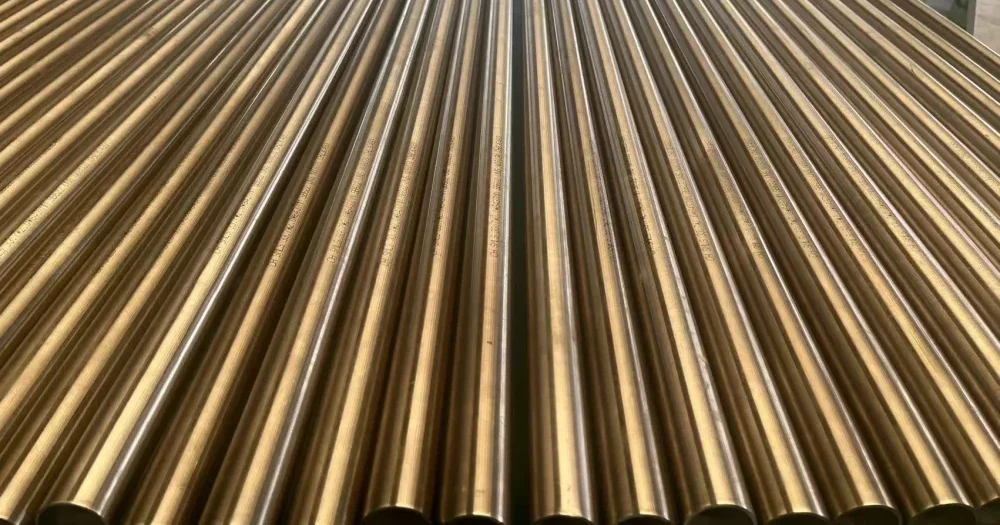
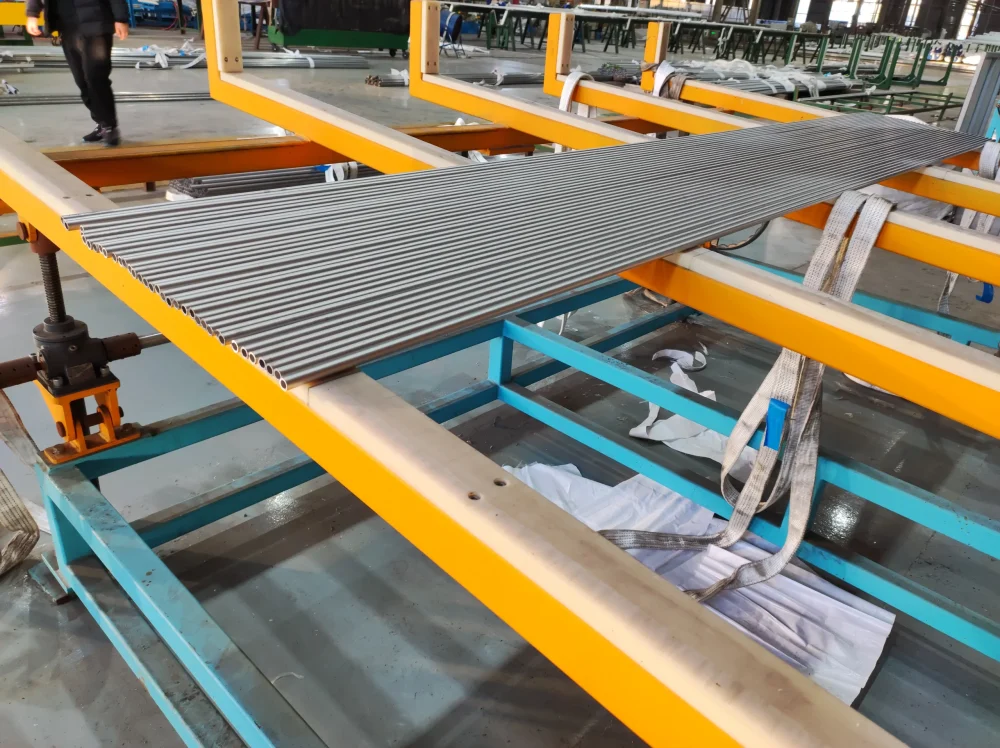
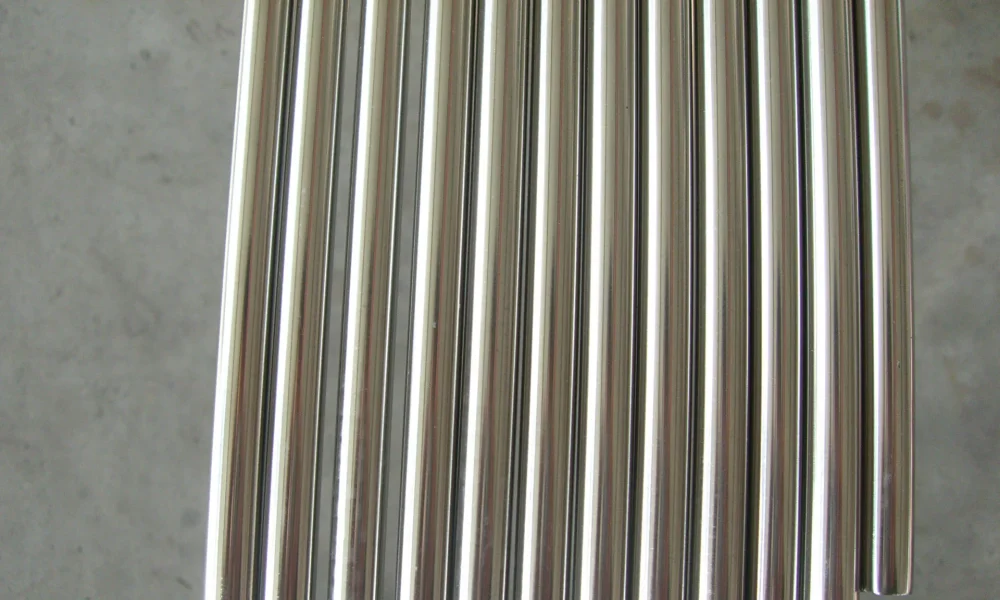
4J33 Bright Bar
4J33 bright bar is a high-precision cold-worked metal bar manufactured from 4J33 alloy through processes such as cold drawing,cold peeling,or polishing,resulting in a smooth,bright surface.4J33 is a special iron-nickel-cobalt (Fe-Ni-Co) controlled-expansion precision alloy,typically classified as a Kova alloy.
Core Characteristics of 4J33
- Ceramic Sealing Match:
Its defining feature is a linear thermal expansion coefficient between -60°C and 600°C that closely matches 95% Al₂O₃ (Alumina) ceramics. - Composition chimique :
It primarily consists of roughly 32.1% to 33.6% Nickel and 14.0% to 15.2% Cobalt,with the remaining balance being Iron along with trace amounts of manganese and silicon. - Stabilité de phase :
It is engineered to maintain structural and expansion stability at cryogenic temperatures without undergoing unwanted phase transitions.
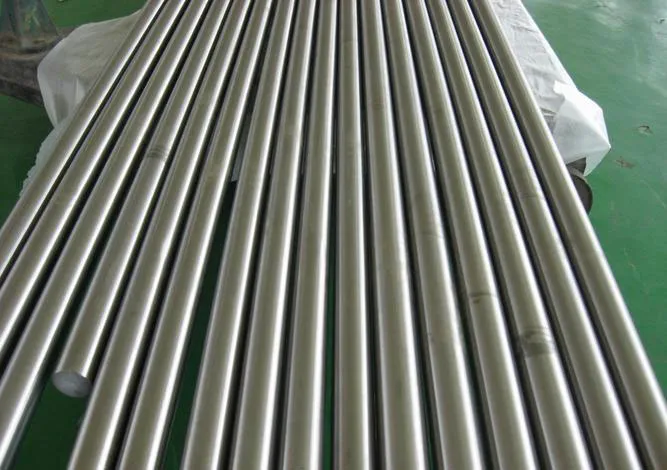
Applications of 4J33 Bright Bar
- Hermetic seals
- Alumina joints
- Ceramic feedthroughs
- Power connectors
- Vacuum tubes
- Magnetron pins
- Cathode supports
- Transmitter valves
- Rocket sensors
- Avionics housing
- Satellite chassis
- Cryogenic valves
We offer 4J33 (ASTM F15 / GB/T 15018) bright bars in diameters ranging from OD 2mm to 201mm,manufactured in compliance with ASTM F15, DIN 17744, and GB/T 15018.
We also supply high-performance alloy tubes et tuyaux (including Hastelloy , Inconel , Incoloy etc.) that are fully compliant with PED 2014/68/EU and CE marks for vacuum engineering and precision applications.
All our production and testing processes are certified to ISO 9001, and all products are delivered with EN 10204 3.1 Mill Test Certificates ensuring optimized ceramic-to-metal matching thermal expansion coefficients (specifically for 95% Al₂O₃ alumina).With over a decade of experience in manufacturing,import,and export,we are your most trusted wholesaler in China.
Chemical Composition of 4J33 Bright Bar
The 4J33 Bright Bar is a precision Fe-Ni-Co controlled expansion alloy.Its chemical composition is strictly regulated by international and domestic manufacturing standards—primarily GB/T 15018 and closely related to ASTM F15 / UNS K90330 formulations—to ensure exact thermal expansion replication.
| Ni | Co | Mn | Si | C | P | S | Fe |
|---|---|---|---|---|---|---|---|
| 32.10 – 33.60 | 14.0 – 15.20 | ≤ 0.50 | ≤ 0,30 | ≤ 0.05 | ≤ 0,02 | ≤ 0,02 | Équilibre |
Precision Ceramic-Matching Linearity
The specific balance of 33% Nickel and 14.5% Cobalt yields a linear expansion curve that matches 95% Al₂O₃ alumina ceramic across a wide temperature threshold (-60°C to 600°C).Altering the Nickel or Cobalt concentration by even 0.5% shifts the thermal expansion properties,which can cause micro-cracking during vacuum brazing.
Cryogenic Microstructural Phase Stability
Standard iron-nickel configurations risk undergoing a martensitic transformation (shifting atomic arrangement from austenite to martensite) when exposed to freezing or sub-zero environments.The exact ratios in 4J33 keep the matrix reliably austenitic down to cryogenic levels (-253°C),preventing volumetric distortions in space or deep-vacuum setups.
Low-Carbon Trace Controls
By locking Carbon at ≤ 0.50% (often aimed at ≤ 0.02% in premium vacuum induction melting),the alloy avoids the formation of brittle internal carbides.This ultra-clean microstructure prevents outgassing issues under extreme high-vacuum (UHV) applications,keeping the vacuum chamber pristine.
Surface Chemistry & Bright Processing
Cold rolling,centerless grinding,or peeling have removed the standard hot-rolled scale.Chemically,this leaves an ultra-pure,oxide-free surface skin.During automated CNC machining,this pristine surface allows immediate,high-uniformity oxidation treatment—a step required to build a gray-blue interdiffusion oxide layer that bonds seamlessly to liquid ceramic formulations.
4J33 Bright Bar Standards & Equivalent Designations
| 4J33 Bright Bar (Controlled Expansion Precision Alloy) | |||||
|---|---|---|---|---|---|
| Standard | Désignation équivalente | Forme du produit | GB (Chine) | GJB (Military) | GOST (Russia) |
| Norme chinoise | 4J33 (Fe-Ni33-Co17) | Bright Bars & Cold-Drawn Rods | YB/T 5234 GB/T 15018 | GJB 1952A GJB 3322A | – |
| Russian / CIS | 33NK (33НК) | Hot-Rolled Bars & Forging Rods | – | – | GOST 10994 GOST 14080 |
| ISO | FeNi33Co17 | Seamless Pipes & Capillary Tubes | – | – | – |
| Trade Name | Ceramic Sealing 33, Alumina-Matching Alloy | Precision Strips, Wires & Sheets | – | – | – |
Vous avez un besoin ?
Kaysuns is a professional supplier of 4J33 Bright Bar.Please feel free to contact me if you have any requirements.
Contactez-nous pour plus d'informations
Mechanical Properties of 4J33 Bright Bar
The mechanical properties of a 4J33 Bright Bar are heavily influenced by its cold-working history (cold drawing,peeling,or centerless grinding) and subsequent heat treatment cycles.Because 4J33 is primarily engineered for precision thermal expansion stability,its mechanical strength must be balanced to ensure excellent machinability on CNC lathes and structural integrity after high-temperature vacuum brazing.
| Propriété mécanique | Annealed State | Hard-Drawn State | Testing Standard / Notes |
|---|---|---|---|
| Résistance à la traction | 490 – 590 MPa | ≥ 680 MPa | GB/T 15018 / ASTM F15 |
| Limite d'élasticité | 290 – 390 MPa | ≥ 540 MPa | Typical values for reference |
| Élongation | ≥ 25% | ≤ 10% | Gauge length = 50mm |
| Dureté | ≤ 170 HBW (≤ 85 HRB) | ≥ 220 HBW (≥ 95 HRB) | Bright bars favor optimal machining hardness |
| Module d'élasticité | 138 – 147 GPa | 145 – 155 GPa | Decreases as temperature climbs |
| Poisson’s Ratio | 0.30 | 0.30 | Dimensional structural baseline |
Bright Processing VS Machinability Mechanics
Hot-rolled 4J33 is naturally gummy and prone to work-hardening, which leads to poor surface finishes and rapid CNC tool wear.The cold-processing stage that creates a Bright Bar deliberately increases the material’s surface hardness (upwards of 220 HBW) and yield strength. This elevated hardness changes the chip formation dynamics,allowing cleaner chip shearing,tighter dimensional tolerances,and a mirror-like finish during high-speed turning.
Deep Structural Anisotropy & Internal Stress
Cold drawing creates a directional grain structure along the longitudinal axis of the bright bar.This deformation induces significant internal mechanical stress.If these residual stresses are not managed, the bar can distort or warp during aggressive machining or when exposed to high temperatures.For ultra-precision vacuum components,manufacturers utilize centerless-peeled or stress-relieved bright bars to guarantee dimensional stability.
Post-Brazing Mechanical Degradation
During ceramic-to-metal sealing, the assembled joint is heated to brazing temperatures (typically 800°C to 1000°C in a protective atmosphere or vacuum furnace).This process acts as a full anneal, eliminating the mechanical strength gained from cold working.The tensile strength drops back to the annealed baseline (~500 MPa),and the material softens.Design engineers must account for this drop, ensuring the final structural component relies on the annealed property limits rather than the initial bright bar hardness.
Fatigue and High-Temp Creep Resistance
At elevated operating levels (up to 500°C in high-power transmitter valves or aerospace avionics),4J33 exhibits excellent creep resistance due to its cobalt content.The 14.5% Cobalt addition reinforces the iron-nickel austenitic matrix,allowing the bright bar components to retain their structural shape and seal integrity under cyclical thermal stresses without undergoing structural relaxation.
Our Advantages in Manufacturing 4J33 Bright Bar
Advanced Smelting Technology
We utilize a state-of-the-art Vacuum Induction Melting coupled with Electroslag Remelting process to refine our raw materials.This dual-refining technique thoroughly eliminates trace impurities and gas inclusions,locking harmful elements like sulfur and phosphorus at exceptionally low limits.The resulting ultra-clean metallurgical structure prevents micro-voiding during high-temperature brazing and ensures zero outgassing in ultra-high vacuum applications.
Precision Dimensional Accuracy
Our production facility is equipped with automated cold-drawing lines and centerless grinding machinery capable of holding exceptionally tight diameter tolerances up to h7 or h8 levels.By stripping away all hot-rolled oxide scales,our specialized peeling and polishing processes deliver a flawless,high-brightness surface finish with exceptionally low surface roughness.This precise geometric uniformity ensures seamless feeding into high-speed CNC automated lathes,significantly reducing tool wear and machining downtime.
Certified Matched Expansion
Every batch of our bright bars undergoes rigorous dilatometric testing to guarantee that the linear thermal expansion coefficient precisely matches 95% Al₂O₃ alumina ceramics across the critical temperature threshold from -60°C to 600°C.Our specialized thermal stabilization treatment guarantees a stable austenitic matrix that will not undergo structural or martensitic phase transformations even when exposed to deep cryogenic environments,eliminating the risk of catastrophic seal failures.
Complete Quality Traceability
Our entire manufacturing and inspection workflow operates under a rigid ISO 9001 certified quality management system to ensure comprehensive process tracking from initial ingot to final shipment. Each delivery is accompanied by an authentic EN 10204 3.1 Mill Test Certificate that provides full disclosure of actual chemical compositions,mechanical stress tests,and physical expansion curves. Backed by over a decade of international trade experience,we provide verified technical compliance for global aerospace and vacuum engineering sectors.
FAQs About 4J33 Bright Bar
Before sealing 4J33 to alumina ceramics,components must undergo a specialized pre-oxidation process.After thorough degreasing and hydrogen annealing,the parts are heated in a wet hydrogen or controlled atmosphere at 800°C to 900°C for 30 to 60 minutes.This creates a dense, tightly adherent gray-blue oxide film on the surface,which acts as the chemical bonding bridge that liquid brazing filler metals wet against to form an airtight joint.
While both are controlled expansion alloys within the Fe-Ni-Co family,their exact thermal expansion footprints target completely different mating materials.4J29 is specifically formulated with approximately 29% Nickel and 17% Cobalt to match the expansion curves of hard borosilicate glasses.In contrast,4J33 contains slightly more Nickel (~33%) and less Cobalt (~14.5%),shifting its expansion coefficient higher to precisely match 95% Al₂O₃ alumina ceramics rather than glass formulations.
Like most high-nickel alloys,4J33 is naturally gummy and work-hardens rapidly if subjected to friction rather than clean shearing.When machining bright bars on CNC,engineers should utilize sharp tungsten carbide or high-speed steel tools with positive rake angles.Maintain a constant,heavy feed rate paired with low-to-medium cutting speeds,and always apply high-pressure,sulfur-free chlorinated cutting fluids to efficiently dissipate heat and wash away chips.
Yes,4J33 exhibits excellent weldability using standard precision methods such as Laser Beam Welding,Electron Beam Welding,and Gas Tungsten Arc Welding.When filler metal is required,it is highly recommended to use matching 4J33 alloy wires to preserve identical thermal expansion behavior across the weldment joint.If structural strength is preferred over strict expansion matching in non-sealing zones,nickel-based fillers like Inconel 625 can be utilized.
Nous contacter
Prendre contact
- RM901 No.22 Tangjiaqiao Road Wenzhou Chine
- +86 577 8551 1171
- [email protected]
- https://www.kaysuns.com/
Trouvez-nous