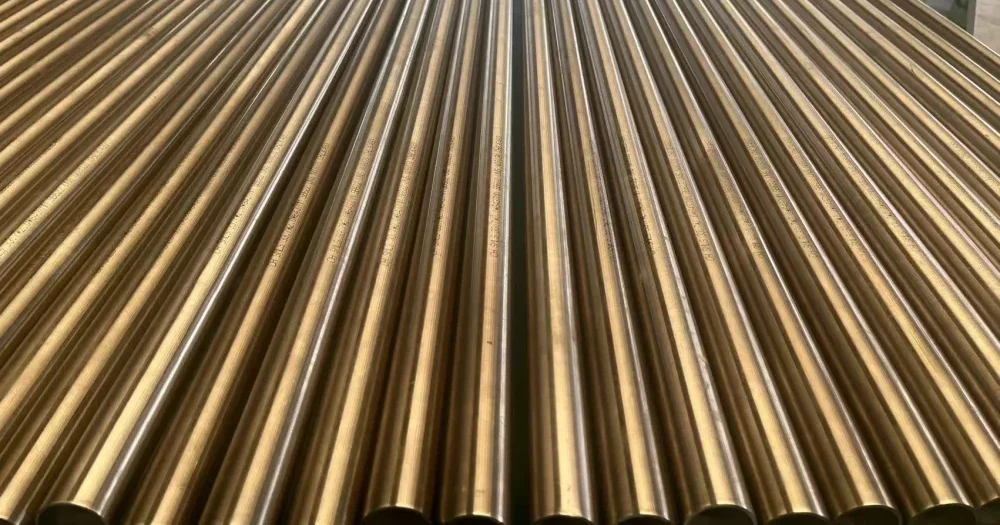
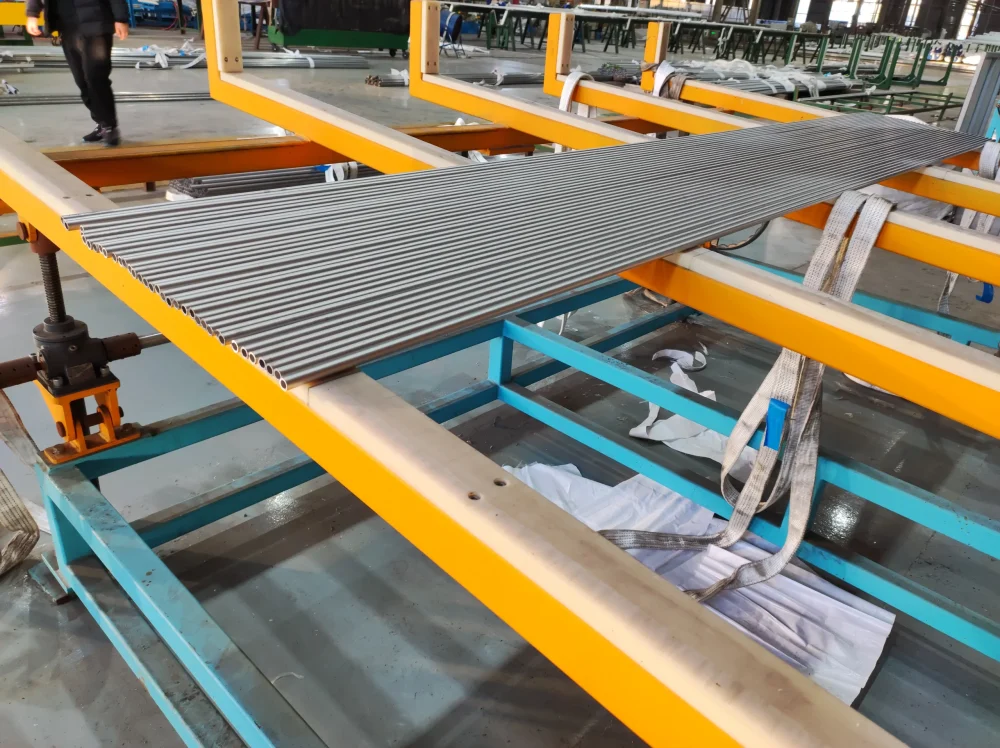
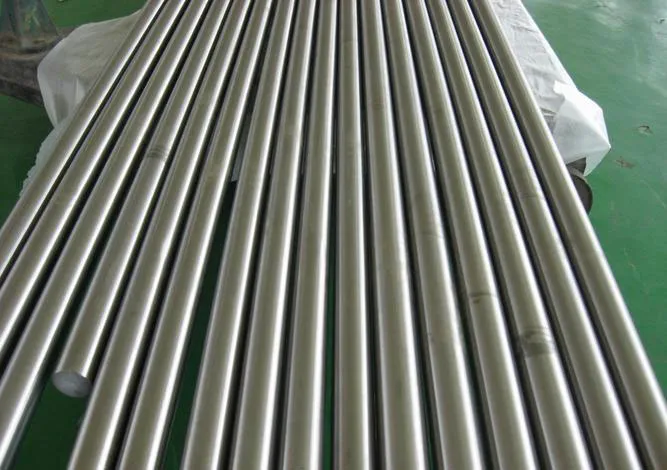
1J36 Plate
A 1J36 plate is a precision metal sheet or plate made from a nickel-iron soft magnetic alloy that features low thermal expansion and high magnetic permeability.It is highly chemically identical to Invar 36 (FeNi36),consisting of roughly 36% nickel and a balance of iron.Under industrial standards like China’s GB/T 15018,the “1J” prefix explicitly denotes that it belongs to the soft magnetic alloy category.
Principales características de rendimiento
- Low Coefficient of Thermal Expansion:
Volume and dimensional stability remain virtually unchanged over a wide temperature range. - High Magnetic Permeability:
Easily magnetized and demagnetized,it effectively guides and concentrates magnetic field lines. - High Saturation Induction:
It can withstand a strong magnetic flux before reaching saturation.
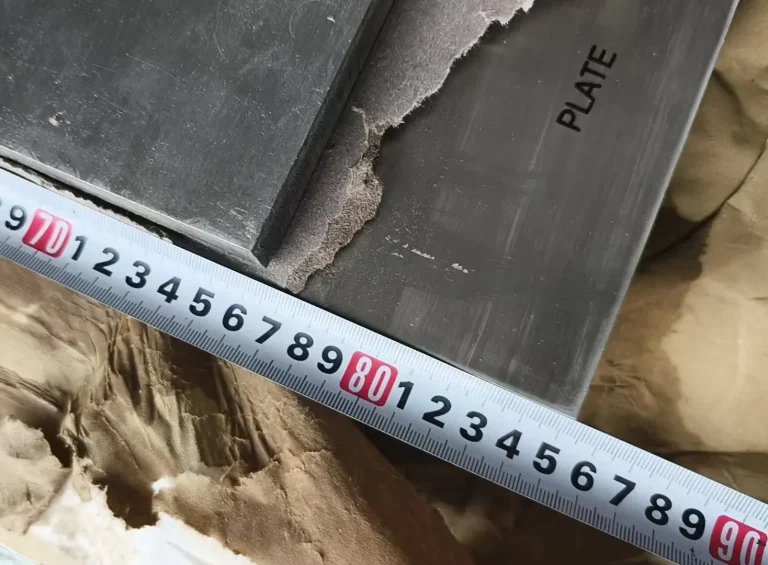
Applications of 1J36 Plate
- Magnetic Shielding
- Transformer Cores
- Componentes aeroespaciales
- Precision Instruments
- Relay Components
- Shadow Masks
- Laser Equipment
- Cryogenic Tanks
- Industrial Sensors
- Circuit Breakers
We offer 1J36 plates and sheets in thicknesses of 1.5 – 151.We offer not only placas de acero inoxidable and sheets but also plates made of Hastelloy,Incoloy,Inconel,Monel,and other alloys.Our products comply with ASTM A240,EN 10204,ISO 9001,PED 2014/68/EU ,CE,and other standards.With over a decade of experience in manufacturing and import/export,we are your best wholesaler in China.
Chemical Composition of 1J36 Plate
The composition is tightly controlled.Nickel functions as the primary alloying agent,while trace impurity limits are strictly constrained to keep the material’s structural dimensions stable and its magnetic pathways clear.
| Ni | Fe | C | Si | Minnesota | P | S |
|---|---|---|---|---|---|---|
| 35.0 – 37.0 | Equilibrio | ≤ 0.03 | ≤ 0.20 | 0.20 – 0.60 | ≤ 0,02 | ≤ 0,02 |
Microstructure and Metallurgical
- Single-Phase Austenite:
1J36 features a stable face-centered cubic (FCC) austenitic crystal structure across its entire working temperature range.It does not undergo phase transformations during heating or cooling,ensuring that structural dimensions stay reliable. - The “Invar Effect” Mechanism:
At room temperature,the alloy is ferromagnetic.As temperature rises,thermal vibration causes the crystal lattice to expand.However,this expansion is precisely counterbalanced by a spontaneous contraction caused by changes in its internal magnetic alignment (magnetostriction).This simultaneous counter-action keeps the overall volume remarkably stable.
Key Physical & Magnetic Properties
- Density:
8.1 g/cm³ - Curie Point:
~230°C.Below this point,it is soft-magnetic and exhibits ultra-low thermal expansion.Above this point,it loses its magnetic ordering and its thermal expansion rate increases to look like a standard carbon steel. - Coefficient of Thermal Expansion (CTE):
~1.2 × 10⁻⁶/°C (between -20°C and 100°C),roughly one-tenth the expansion rate of structural steel.
Processing & Welding Considerations
- Cold Deformation:
The plate has great ductility and is easily cold-rolled.It cannot be hardened via heat treatment;it relies exclusively on cold-working for strength additions. - Welding Requirements:
When welding 1J36 plates,maintaining the chemical composition across the weld seam is critical.Standard filler metals can change the local nickel concentration,ruining the low-expansion properties at the joint.Argon arc welding using specialized matching nickel-iron wire is standard practice to prevent porosity and thermal cracking.
1J36 Plate Standards & Equivalent Designations
| 1J36 / Invar 36 Alloy (Low Expansion & Soft Magnetic) | |||||
|---|---|---|---|---|---|
| Estándar / Sistema | Designación equivalente | Forma del producto | GB | GJB | GOST |
| Norma china | 1J36 / 4J36 (Fe-Ni36) | Plates, Sheets & Strips | GB/T 14986 / 15018 | GJB 1952A | – |
| Russian / CIS | 36N / 36H (36Н) | Bars & Rods | GB/T 14985 | – | GOST 14080 / 10994 |
| ISO Chemical Name | Ni36 / FeNi36 | Seamless Pipes & Tubes | – | – | – |
| UNS System | UNS K93600 / K93603 | Welded Pipes & Tubes | – | – | – |
| Aviation / Aerospace | ASTM F1684 / W.Nr. 1.3912 | Forgings & Rings | – | – | – |
| UK Designation | NILO Alloy 36 / Pernifer 36 | Wires & Profiles | – | – | – |
| Generic Trade Name | Invar 36, Alloy 36 | All Available Forms | – | – | – |
¿Tiene alguna necesidad?
Kaysuns is a professional supplier of 1J36 Plates.Please feel free to contact me if you have any requirements.
Más información
Mechanical Properties of 1J36 Plate
The mechanical properties of a 1J36 plate vary extensively based on its delivery condition—specifically whether it is in the annealed (soft) state or the cold-rolled (hardened) state.Unlike structural steels,1J36 cannot be hardened via heat treatment;it relies purely on cold working to gain mechanical strength.
| Propiedades mecánicas | Annealed State (Soft) | Cold-Rolled State (Hard) | Notes / Testing Baseline |
|---|---|---|---|
| Ultimate Tensile Strength | 450 – 550 MPa | 650 – 850 MPa | Shows a dramatic strength surge through work hardening. |
| Fuerza de producción | 240 – 340 MPa | 550 – 750 MPa | 0.2% residual deformation limit under stress. |
| Elongation at Break | ≥ 35% – 42% | ≤ 2% – 10% | Highly ductile in the soft state; brittle when full hard. |
| Dureza Brinell | ≤ 160 – 200 HB | 220 – 270 HB | Critical parameter for processing tool wear. |
| Módulo de elasticidad | 144 GPa | ~148 GPa | Stiffer than aluminum,more flexible than structural steel. |
| Shear Strength | 320 – 380 MPa | – | Base structural calculation parameter. |
Cryogenic Mechanical Performance
- No Cryogenic Embrittlement:
One of the most unique mechanical characteristics of 1J36 is that it maintains its excellent face-centered cubic structural stability at ultra-low cryogenic levels. - Increased Strength:
When dropped to liquid nitrogen (-196°C) or liquid helium temperatures, its tensile strength can escalate beyond 900 MPa without triggering a sharp drop in impact toughness.This makes the plate ideal for aerospace and LNG storage tanks.
Machining & Fabrication Characteristics
- Sticky Austenitic Matrix:
Mechanically,1J36 behaves similarly to an austenitic stainless steel during cutting operations.Due to its high nickel profile,it exhibits “gummy” properties that lead to rapid work hardening during drilling,milling,or shearing if appropriate sharp tooling is not introduced. - Relief Annealing:
If complex cutting or stamped bending forces introduce structural stresses into the plate,a vacuum relief anneal is mandatory to mechanically restore dimensional baselines and re-align internal magnetic vectors.
Impact of Cold Rolling on Magnetic vs. Mechanical Properties
- Annealed State (Optimized Magnetics & Low CTE):
Soft annealing leaves the grain boundaries free of strain.This state achieves the lowest coefficient of thermal expansion and the highest magnetic permeability but provides weak physical yield strength. - Cold-Rolled State (Optimized Structural Strength):
Cold rolling creates internal lattice distortions and dislocation clusters.This elevates hardness and tensile yield strength for structural integrity.However,the residual stress degrades the soft magnetic pathway performance and slightly expands the CTE.
Our Advantages in Manufacturing 1J36 Plate
Advanced Smelting Technology
We utilize VIM combined with VAR to produce highly purified alloy matrices.By strictly limiting harmful trace elements like carbon,phosphorus,and sulfur to near-zero levels,we ensure a clean metallurgical profile.This high purity prevents magnetic aging and keeps the material’s soft-magnetic behavior stable.
Stable Magnetic Performance
Our engineered heat treatment curves are tailored to achieve the highest possible magnetic permeability and saturation magnetic induction.We precisely eliminate internal lattice stresses,maximizing the soft magnetic properties of the 1J36 alloy.This guarantees low coercive force and highly efficient magnetic flux channeling in your final components.
Precision Dimension Control
We implement automated,high-precision rolling mills and advanced tension levelers to produce sheets with exceptional flatness tolerances and highly uniform thickness profiles.This dimensional consistency minimizes geometric deviations,making our plates perfectly optimized for precision stamping,chemical etching,and laser cutting lines.
Rigorous Quality Assurance
Every batch of 1J36 plates undergoes extensive destructive and non-destructive evaluations before dispatch.We perform 100% verification on magnetic parameters ,metallurgical grain size,and ultrasonic internal soundness.Each shipment is fully backed by certified MTRs to guarantee compliance with GB/T 14986 standards.
FAQs About 1J36 Plate
The core difference lies in their industrial classification and testing standards.Both materials share the same basic chemistry (~36% Nickel-Iron, known as Invar 36).
- 1J36 is classified as a soft magnetic alloy under standards like GB/T 14986.It is tested and optimized for magnetic permeability and low coercive force.
- 4J36 is classified as an expansion alloy under standards like GB/T 14985. It is optimized and verified primarily for its ultra-low CTE.
Yes,significantly.Cold rolling introduces lattice distortion and internal stresses.This increases mechanical strength and hardness,but it degrades magnetic performance and slightly increases the CTE.For applications requiring maximum magnetic shielding or the lowest possible expansion,the plate must be used in its fully annealed state.
The low thermal expansion is highly effective up to its Curie point,which is approximately 230°C (446°F).Below this temperature,the alloy is ferromagnetic and maintains near-zero expansion.Once it exceeds 230°C,it loses its magnetic ordering,and its thermal expansion rate increases sharply,behaving like a normal carbon steel.
It is moderately difficult because of its high nickel content,behaving similarly to austenitic stainless steel.It is “gummy” and work-hardens rapidly.To machine it successfully without warping the plate,you must use sharp tungsten carbide tools,high cooling fluid flow,low cutting speeds,and a constant,positive feed rate.
Exceptionally well.Because of its stable face-centered cubic (FCC) crystal structure,1J36 does not undergo low-temperature embrittlement.At liquid nitrogen (-196°C) or liquid helium temperatures,it retains excellent impact toughness while its tensile strength actually increases,making it ideal for cryogenic and aerospace piping.
Contacto
Póngase en contacto con nosotros
- RM901 No.22 Tangjiaqiao Road Wenzhou China
- +86 577 8551 1171
- [email protected]
- https://www.kaysuns.com/
Encuéntranos