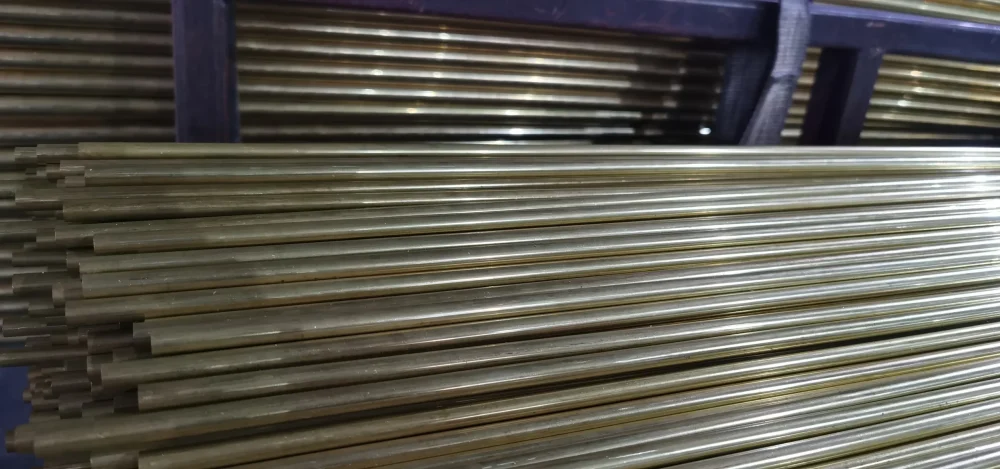
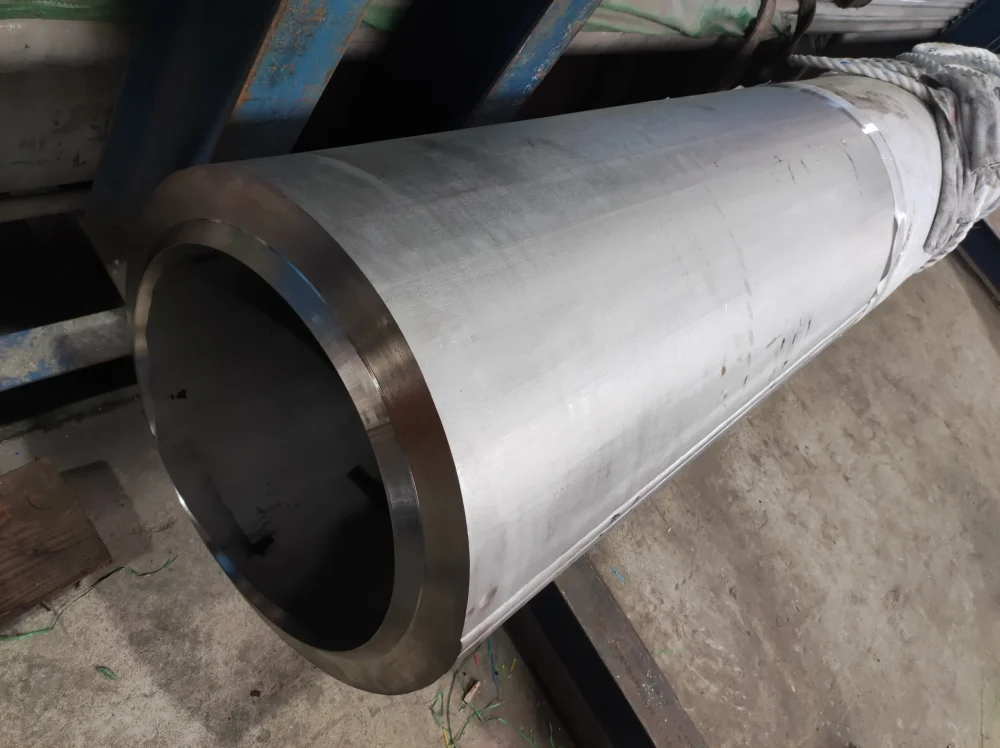
PMI testing stands as the most critical quality control step for modern stainless steel piping systems.When you order industrial components,you must verify their chemical composition.Simply trusting a label is not enough in high-stakes industries.Positive Material Identification (PMI) provides a fast and non-destructive way to analyze metal alloys.This process ensures that your stainless steel pipes,fittings,and flanges meet exact engineering specifications.
What is PMI Testing?
At its core,PMI testing is a method used to identify the chemical makeup of a metal.It measures the percentage of key elements like Chromium,Nickel,and Molybdenum.For example,it can instantly tell the difference between 304 stainless steel pipes and 316L stainless steel pipes.While they look identical to the naked eye,their performance in corrosive environments is very different.
Kaysuns’ technicians use this technology to inspect both installed pipes and flanges in the warehouse.This real-time feedback helps prevent the use of “non-conforming” materials;therefore,all products manufactured by Kaysuns must pass this inspection to ensure compliance.
What We Do
- Plate
- Sheet
- Forgings
- Round Bar
- Flange
- Pipes
- Fittings
- Customized
Contact Us For More Information
The Role of PMI Testing in Piping Systems
1. Stainless Steel Pipes and Quality Checks
Pipes form the “arteries” of your industrial plant.If a pipe has the wrong alloy mix,it may corrode prematurely.For instance,high-pressure systems often require an x-ray test to check weld internal quality.However,the X-ray test does not tell you the metal grade.Therefore,you must use a PMI test to confirm the alloy chemistry before the pipe enters service.
2. Ensuring Compatibility with a PMI Test for Fittings
Pipe fittings like elbows,tees,and reducers change the flow direction.These areas often experience turbulent conditions and high stress.Using PMI testing on fittings ensures that every elbow matches the pipe grade.This prevents “galvanic corrosion,”which happens when two different metals meet in a liquid.
3. Verification of Forged Flanges
Flanges are used to connect pipes to pumps,valves,and storage tanks.Since flanges are typically forged in batches,there is a risk of material mix-ups.PMI testing serves as the final quality control measure.It ensures that the material of your stainless steel flanges is not mixed up and prevents the use of cheaper substitutes.
Key Benefits of Implementing PMI Testing
| Benefit | Description | Long-term Result |
|---|---|---|
| Safety | Prevents incorrect materials in hazardous areas. | Reduces accident risk |
| Compliance | Meets strict ASTM, ASME, and API industrial standards. | Passes audits easily |
| Cost Savings | Avoids expensive repairs and unplanned shutdowns. | Higher ROI |
| Speed | Provides results in seconds rather than days. | Faster project delivery |
| Verification | Confirms the accuracy of Mill Test Reports (MTR). | Total Peace of Mind |
Equipment for Accurate PMI Testing
- XRF (X-ray Fluorescence Spectroscopy):
This is the most commonly used analytical tool.It directs low-energy X-rays at a metal sample,causing the metal atoms to emit secondary X-rays.The instrument determines the chemical composition of the metal by analyzing these X-rays. - OES (Optical Emission Spectroscopy):
This method uses a tiny spark to vaporize minute amounts of metal.By analyzing the spark’s spectrum,elements such as carbon can be detected.XRF equipment,however,has difficulty detecting carbon.
How is the PMI Test Performed?
The process for a PMI test is straightforward but requires a trained eye.First,the technician cleans the surface of the stainless steel.Any paint,rust,or grease could interfere with the sensors.Next,they place the nose of the analyzer against the metal.
After pulling the trigger,the screen displays the alloy grade within 10 seconds.Finally,the technician records the data.In many high-pressure projects,engineers also require a hydro test to check for leaks.Combining chemical verification with pressure testing creates a truly robust system.
Comparison of PMI Testing Equipment Technologies
| Feature | XRF (Handheld) | OES (Spark) |
|---|---|---|
| Portability | Very High (Battery operated) | Low (Needs gas tanks) |
| Carbon Detection | No | Yes |
| Surface Prep | Minimal | High (Grinding needed) |
| Non-Destructive | 100% | Leaves a small burn mark |
Why Choose Our Full Piping Solution?
- Raw Material Gate:We test the steel billets before they become pipes.
- In-Process Check:We perform a PMI test during the forging of flanges.
- Final Inspection:Before shipping, every fitting receives a final scan.
We provide a valid PMI test report that includes information such as the equipment serial number and specifies the certification levels of the technicians.
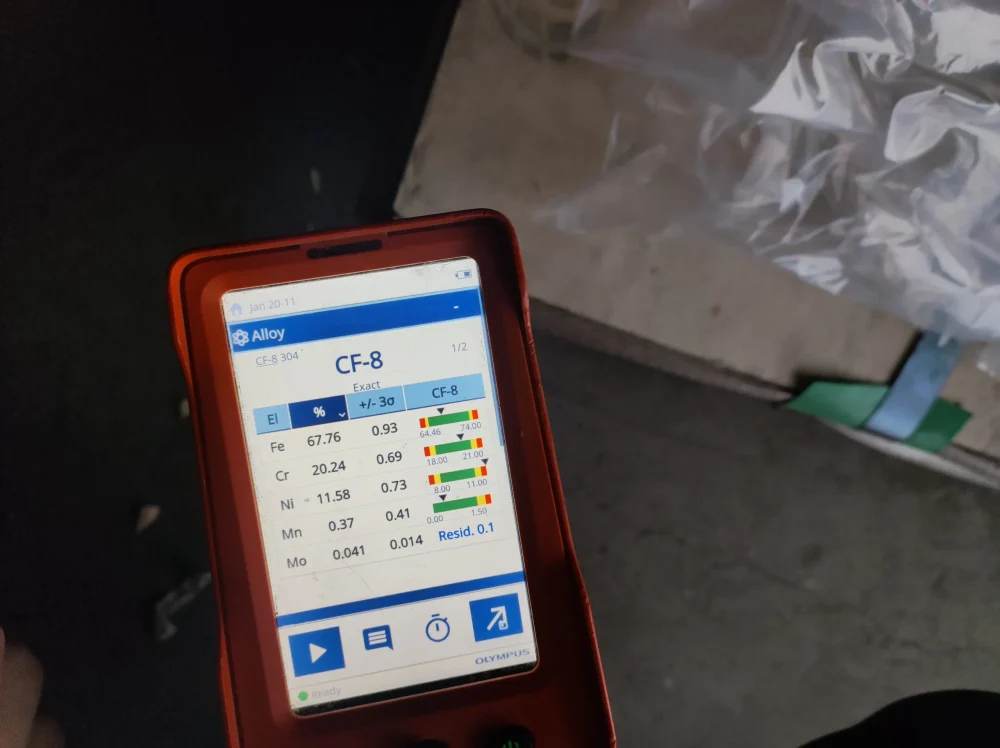
Furthermore,material properties depend on more than just chemical composition.For example,hardness testing is often a necessary means of verifying the heat treatment process for steel.Combining chemical composition (PMI testing),internal structure (X-ray),pressure (hydrostatic testing),and strength (hardness) forms a comprehensive quality control system.This professional approach ensures that your project complies with all global safety standards.
FAQs About PMI Testing
Compared to the cost of a refinery leak,PMI testing is very affordable.It usually adds only a small percentage to the total project cost.
No,most PMI testing happens on-site using portable XRF guns.This saves time and moving costs.
It provides high accuracy for most alloying elements.However,standard X-ray fluorescence spectroscopy (XRF) cannot detect light elements such as carbon;for these elements,spark optical emission spectroscopy (Spark OES) or laser-induced breakdown spectroscopy (LIBS) must be used.
Contact Us
Get In Touch
- RM901 No.22 Tangjiaqiao Road Wenzhou China
- +86 577 8551 1171
- [email protected]
- https://www.kaysuns.com/
Find Us