Table des matières
Incoloy 925 (UNS N09925) and Incoloy 825 share almost the same chemistry table. The difference is the titanium and aluminium dose: 1.9–2.4% Ti with 0.10–0.50% Al against 0.6–1.2% Ti and 0.20% Al maximum. That single change precipitates gamma-prime and lifts yield strength from 271 MPa to 832 MPa. Below is what the dose actually does, how the three-step heat treatment works, where 925 beats 825 in sour service, and the four items to write into a purchase order before you buy.
The source handbook makes an odd remark: the cold forming behaviour of 925 is described as similar to 825, and so is its hot working behaviour. That sounds like a copy-paste until you compare the two composition tables. Nickel 42–46 against 38–46. Chromium 19.5–22.5 against 19.5–23.5. Molybdenum identical at 2.5–3.5. Copper identical at 1.5–3.0. For five of the main elements, the two grades are twins.
Then the mechanical data separates them. Annealed 825 sits at roughly 310 MPa yield. Aged 925 sits at 832 MPa. Close to three times the strength from what looks like the same alloy, and the whole gap is decided by two minor elements.
One Chemistry Table, Two Different Prescriptions
INCOLOY alloy 925 (UNS N09925) has the following specified composition. The 825 column is placed beside it for direct comparison.
Five of the main elements overlap completely. Only titanium and aluminium carry real information, and behind those two numbers sit two completely different metallurgical intentions.
Two jobs for the same element
825 uses titanium to put a fire out. Titanium at 0.6–1.2% is tied to carbon at a ratio of Ti ≥ 6 × C, forming titanium carbide. Carbon is locked away before it can combine with chromium at grain boundaries, which is what prevents sensitisation and intergranular corrosion after welding. The dose only needs to be enough to mop up the carbon. Nothing more is asked of it.
925 uses titanium and aluminium to start one. At 1.9–2.4% Ti plus 0.10–0.50% Al, there is far more of both than carbon could ever consume. The surplus is the raw material for gamma-prime, the Ni3(Al,Ti) phase that does the strengthening. Here the dose has to be generous, because the phase volume fraction depends on it.
Same medicine, different dose. In 825 it is a placebo; in 925 it is the active ingredient. This is also why the two grades are not interchangeable on a purchase order even though their certificates look alike at a glance. If you want the background on the lower-strength grade first, our guide to Incoloy 825 covers it in detail.
What Gamma-Prime Does Inside the Matrix
Precipitation hardening can be explained in one sentence: in the solution-annealed condition the titanium and aluminium atoms sit dissolved in the matrix and do nothing visible; hold the material at 732–749 °C and they come out as nanometre-scale gamma-prime particles, uniformly dispersed through the austenitic grain. A dislocation trying to move now has to cut through those particles or bow around them. The macroscopic result is the jump in yield strength.
The handbook gives a complete three-step cycle, and the order is not optional.
This double-stage aging is the standard route for any gamma-prime alloy. The high-temperature stage grows the core precipitates; the low-temperature stage keeps feeding more of them in, and the two together land on the strength and toughness balance the specification asks for. Skipping the second stage leaves strength on the table. Skipping the first leaves the microstructure wrong altogether.
There is a hard limit as well. The time-temperature-transformation diagram in the handbook shows that overheating the aging step brings out eta and sigma phases, and impact toughness falls sharply once they appear. The aging window is a red line, not a starting point for improvisation — which is why the heat treatment should be specified in the purchase order rather than left to the mill’s discretion.
Mechanical Properties: 271 MPa Against 832 MPa
The handbook reports hot-rolled round bar in three conditions. The numbers are measured, not minimum guarantees.
Read it as a trade, not a free upgrade. Yield triples, and elongation falls from 56% to 27% in exchange. For a packer mandrel or a valve stem that is a good trade. For a component that has to be cold formed after delivery it is not, which is why the delivery condition belongs in the contract.
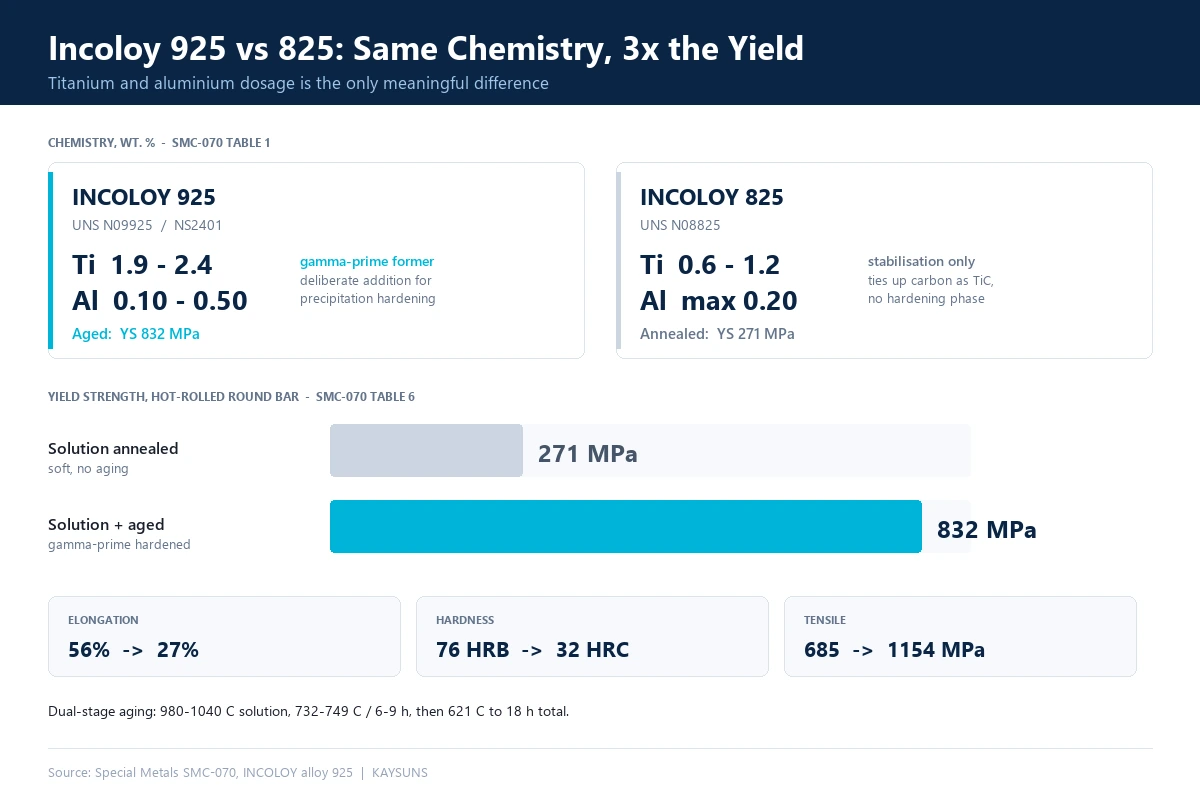
The specification values are stricter than a single test bar suggests. Under the internal specification referenced as HA46, the guaranteed minimums are 965 MPa tensile and 724 MPa yield for cold-worked stock, or 758 MPa for hot-worked stock, with 18% minimum elongation, 47 J minimum Charpy impact at −60 °C, and hardness between 26 and 38 HRC.
One point is easy to overlook: the gamma-prime strengthening holds up to roughly 650 °C. Above that the precipitates coarsen and the advantage erodes. For downhole tools that ceiling happens to sit above most high-pressure, high-temperature service windows, which is exactly why the alloy ended up there.
Corrosion Resistance for Sour Wells
925 inherits its corrosion base from the same recipe as 825. Nickel carries resistance to chloride stress corrosion cracking, molybdenum handles pitting and crevice attack, chromium covers oxidising media, and copper helps with reducing acids. The intended battlefield is the sour well, where hydrogen sulphide, carbon dioxide, chlorides, elemental sulphur and high temperature all arrive at once.
NACE C-ring results
In a NACE solution of 5% NaCl plus 0.5% acetic acid saturated with H2S, with the specimen galvanically coupled to carbon steel and loaded to 100% of yield strength, aged 925 ran 720 hours across multiple heats with no cracking. Hardness in those heats was 38–42 HRC, still inside the range permitted by NACE MR0175.
Autoclave rates with and without sulphur
The more useful comparison is the 15-day autoclave exposure, because it separates the alloys on the variable that actually matters downhole: elemental sulphur at 232 °C.
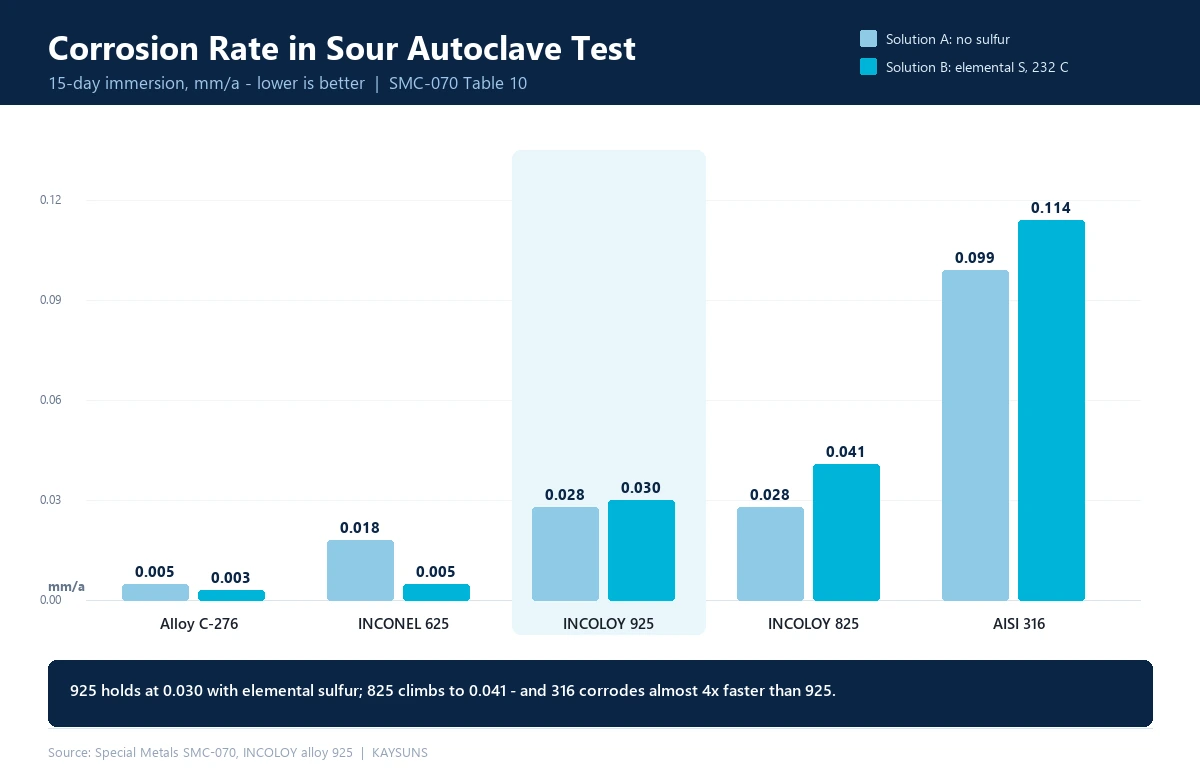
Two things stand out. First, 925 and 825 are level in the sulphur-free solution at 0.028 mm/a, but once elemental sulphur is added at 232 °C the 825 rate climbs to 0.041 while 925 stays at 0.030. That divergence is the technical reason 925 is preferred for hot sour downhole service rather than 825. Second, AISI 316 corrodes at 0.114 mm/a in the same environment, close to four times the 925 rate — a reminder that austenitic stainless is not a substitute in this window.
Crevice and acid service
A 1000-hour crevice test in 3.5% NaCl at 25 °C, using a fluorocarbon gasket to create 40 crevices on each specimen, produced no crevice attack at all and a general rate below 0.03 mm/a. In common acids the alloy behaves as expected: below 0.1 mpy in 0.2% hydrochloric acid at 70 °C, below 0.1 mpy in boiling 10% sulphuric acid, and 0.05 mm/a in 85% phosphoric acid at 70 °C.
Its limitation mirrors 825: strongly oxidising media are not its territory. If the process stream is nitric acid or a hot oxidising chloride, a higher-molybdenum or higher-chromium grade is the right answer. For the sour, reducing side of the map, 925 is squarely in range — and our overview of tube en alliage de nickel puts it next to the alternatives.
Machining: Rough Before Aging, Finish After
The machining logic follows directly from the heat treatment. Aged material is roughly three times stronger, and cutting tools feel it immediately.
Cutting speed in the aged condition is roughly a quarter of the annealed figure. The handbook’s recommendation is therefore blunt: put rough machining before aging, and finishing and tolerance-critical features after it. That saves tool life, and the aging cycle also relieves the stress that rough machining introduced, which stabilises dimensions.
Threaded parts such as valve stems and fasteners follow a standard sequence: roll the threads in the soft condition, then age the finished part. The thread is easier to form, and the compressive surface stress left by rolling continues to contribute to fatigue life after aging.
Welding: You Do Not Weld 925 With 925 Filler
The handbook is explicit that the recommended filler is INCO-WELD 725NDUR, a filler from the INCONEL 725 family, because it delivers higher strength and better corrosion resistance than a matching 925 filler would. The reasoning runs on two levels.
First, a matching-composition weld deposit does not contain enough gamma-prime after solidification to reach the strength of the base metal, so the joint becomes the weak link. Second, 725NDUR is itself a nickel-chromium-molybdenum alloy strengthened by both niobium and titanium-aluminium, and it carries more molybdenum, so the aged deposit ends up not merely matching the parent metal but exceeding it on corrosion. The weld is a reinforcement, not a shadow of the parent metal — the same principle behind using a super-alloy filler such as Inconel 625.
Process limits are tight. GTAW and GMAW are preferred, with GMAW spray transfer capped at 180 A. Submerged arc and shielded metal arc welding are not recommended, because the high heat input puts heat-affected-zone properties out of control.
Post-weld heat treatment is not optional either. In the handbook data, a weld given solution anneal plus aging reached 57 J impact; a weld given aging alone reached 26 J. Skipping the solution step halves weld toughness to save one furnace cycle — a poor trade on a wellhead component.
Applications and Grade Selection
925 is supplied as tube, round bar, flat bar and forgings under specifications including ASTM B805 and B564. The intended uses all sit at the intersection of high strength and corrosion resistance.
Downhole and surface
Downhole: tubing, packers, hangers, landing nipples, tool joints and valves. Surface: sour gas wellhead components, fasteners, pump shafts, marine components and high-pressure piping systems. In every case the alloy is chosen because the part must carry load and survive the same sour stream at the same time. For the piping-system angle on the same alloy, see how Incoloy 925 protects critical piping systems.
Selection is usually decided by two questions: how sour is the stream, and how much load does the part carry. When load dominates, step up to Inconel 718. When the stream is aggressive but loads are moderate, the molybdenum-rich Incoloy 926 is often the cheaper answer. For controlled thermal expansion rather than strength, Incoloy 909 belongs to a different conversation, and the iron-based grades sit at the low-strength end of the same family.
Four Rules When Buying Incoloy 925
1. Confirm UNS N09925, and verify titanium by PMI. The Chinese designation is NS2401. The commercial risk here is not a wrong certificate; it is 825 being supplied in place of 925, because the two look identical on the rack and the visual inspection will not tell them apart. A PMI gun reading titanium settles it in seconds: 825 sits at 0.6–1.2%, 925 must read 1.9–2.4%.
2. Write the delivery condition into the contract. Solution annealed and solution plus aged are two different materials with a threefold difference in yield and a meaningful difference in price. Ordering “Incoloy 925” without a condition leaves the mill a free choice, and the cheaper choice is not the one you want for a packer.
3. Inspect hardness at 26–38 HRC. Below 26 HRC the aging did not complete. Above 38 HRC is a warning sign that precipitation went beyond the intended window and that toughness may have been compromised. Hardness is a fast proxy for whether the heat treatment was actually run.
4. For sour service, require NACE MR0175. Pressure vessels additionally need ASME Code Case 2218, and the material certificate should reference the HA46 specification. Cross-check the grade against a nickel alloy grade comparison table before releasing the order, and if the final component is tubing rather than bar, confirm the dimensional range against the purchase specification.
FAQ
Can Incoloy 925 be substituted for Incoloy 825?
Only as an upgrade, never as a cost-down. 925 delivers about 832 MPa yield against roughly 310 MPa for annealed 825, and its corrosion rate holds when elemental sulphur is present, so it can serve where 825 is strength-limited and a 725NDUR welding procedure is qualified. The reverse is unsafe: 825 will not reach 925’s strength level, and its corrosion rate climbs once sulphur is present.
What hardness should Incoloy 925 be supplied at?
26–38 HRC for aged material. Readings below 26 HRC indicate incomplete aging; readings above 38 HRC suggest precipitation outside the intended window and deserve a toughness check.
Is Incoloy 925 suitable above 650 °C?
The gamma-prime strengthening holds to roughly 650 °C (1200 °F); the SMC-070 data show the alloy keeps most of its strength up to that point. For continuous service well above it, coarsening of the precipitates erodes that advantage, and a solid-solution strengthened grade or a purpose-designed high-temperature alloy is the safer choice.
Why is 925 welded with 725 filler instead of a matching filler?
A matching 925 deposit does not develop enough gamma-prime to match base metal strength, and it carries less molybdenum than 725NDUR. The 725 filler gives a weld that is both stronger and more corrosion resistant than the parent metal, which is the intent when the joint is the weakest point of the assembly.
Contact KAYSUNS
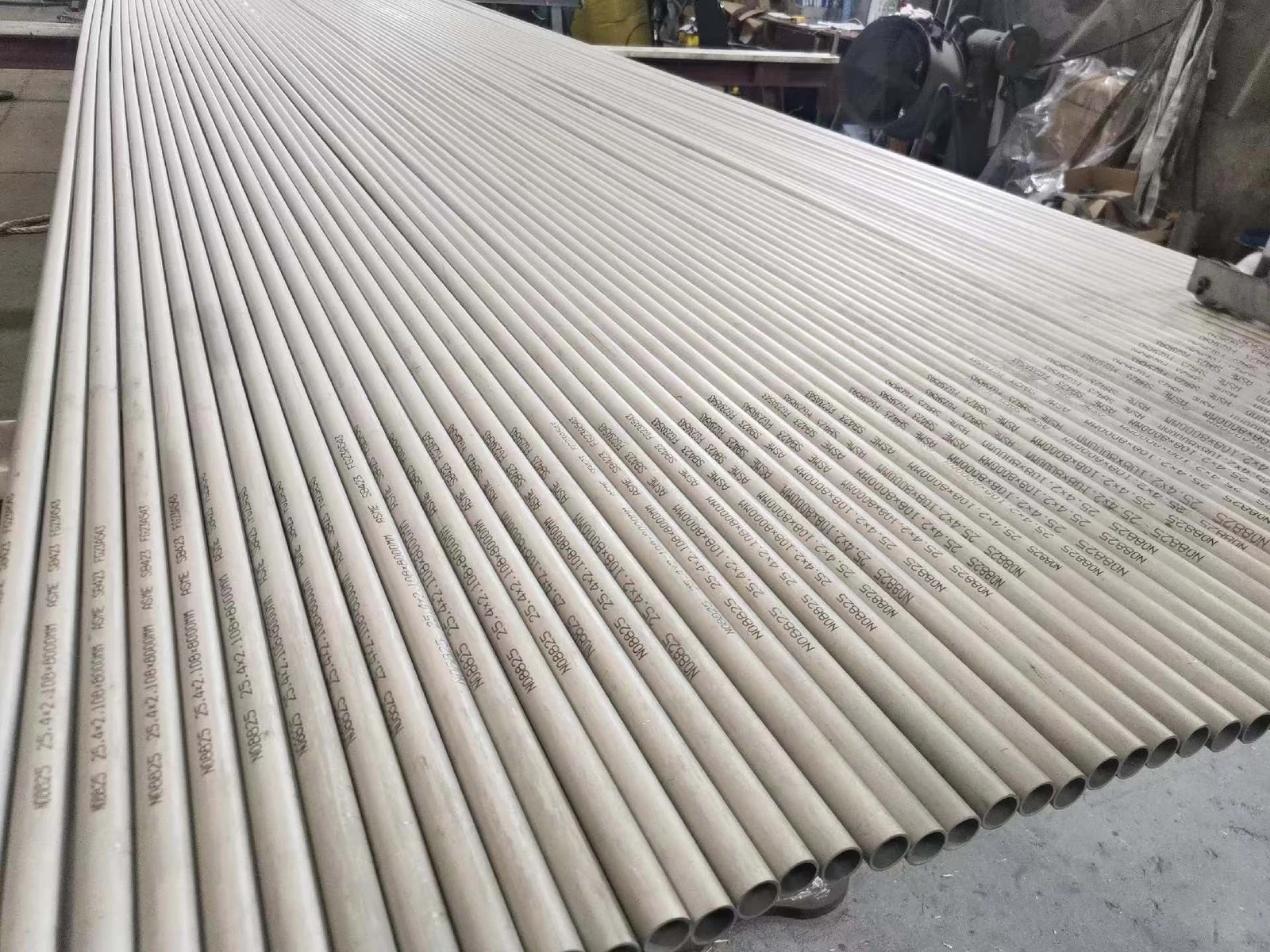
KAYSUNS supplies nickel alloy and stainless steel pipe, tube, fittings, flanges and round bar from China, with mill test certificates to EN 10204 3.1 and third-party inspection on request. For Incoloy 925 bar and forgings, or 825 tubing to ASME SB423, send the size, quantity and delivery condition and we will quote against the correct heat treatment rather than a generic grade name.
Get a Free QuoteTypical reply within 24 hours
Prefer email? Write to [email protected] with your specification. Please state the service environment — H2S partial pressure, chloride level, temperature — so the grade recommendation and the certificate requirements match the application.