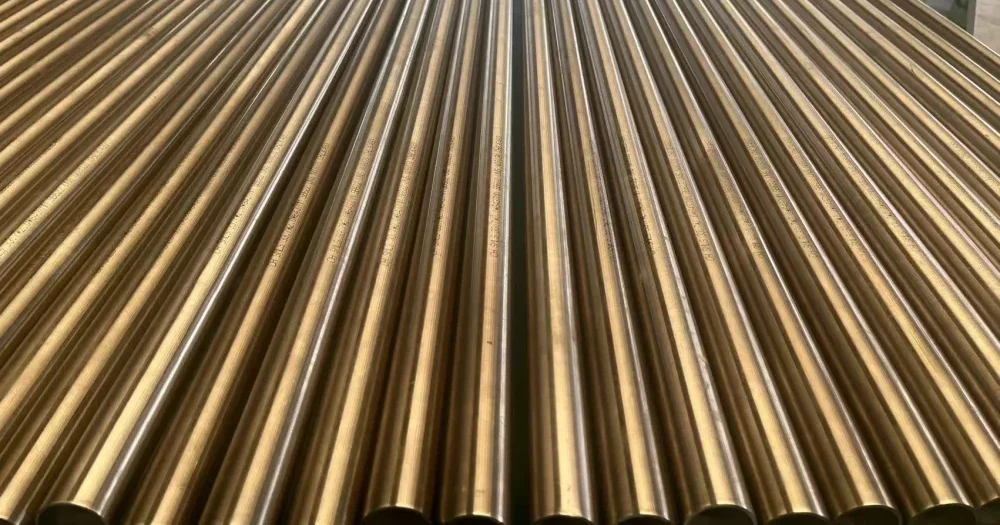
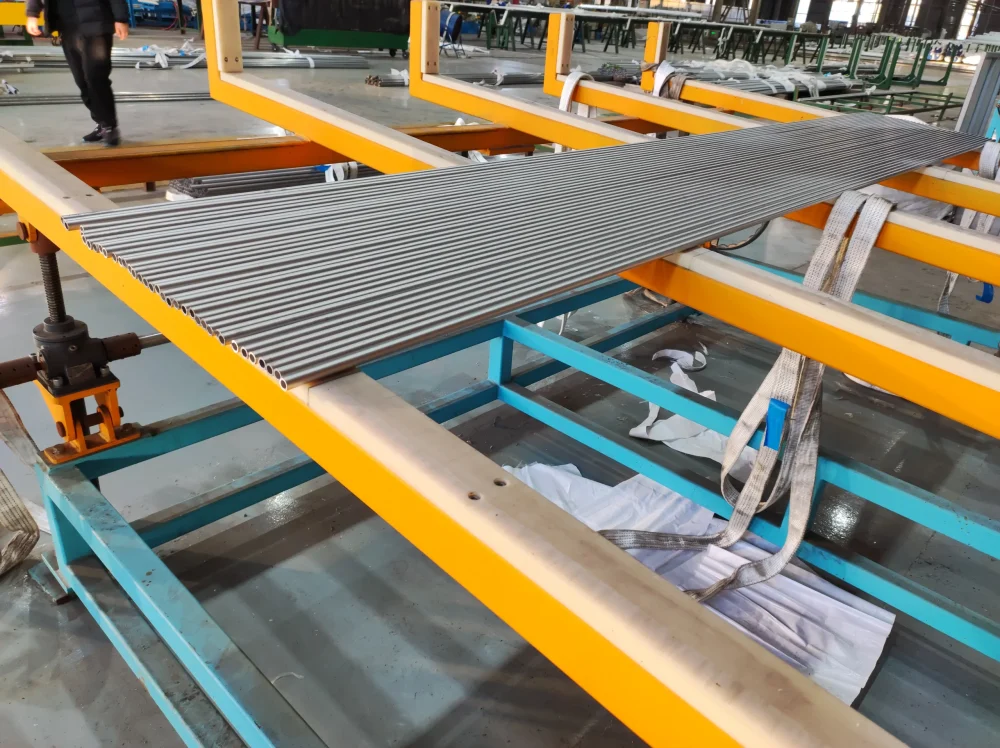
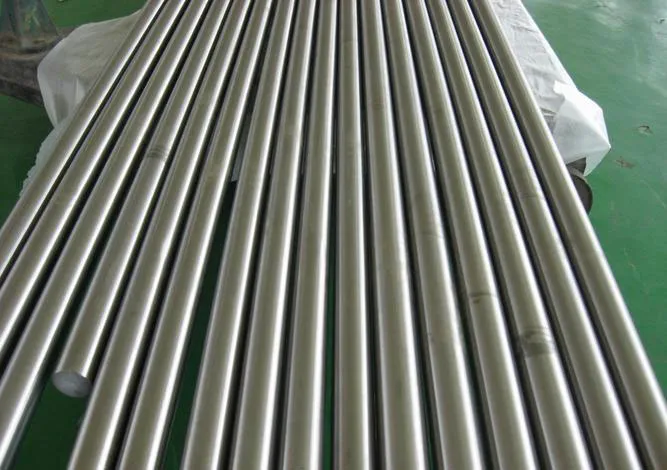
Плита из инвара 36
Плита из инвара 36 is a premium nickel-iron alloy plate known primarily for its uniquely low coefficient of thermal expansion.Composed of approximately 36% nickel and 64% iron,it exhibits near-zero dimensional change when exposed to temperatures ranging from cryogenic levels up to about 400°F (204°C).
Основные характеристики
- Minimal Thermal Expansion:
Its CTE is roughly one-tenth that of carbon steel,ensuring extreme dimensional stability. - Cryogenic Reliability:
It retains excellent strength,toughness,and fatigue resistance at ultra-low temperatures (such as liquid helium or LNG environments). - Magnetic Properties:
Invar 36 is ferromagnetic at room temperature but loses its magnetism when heated above its Curie point of approximately 535°F (279°C). - Отраслевые стандарты:
Commonly produced to meet ASTM F1684,UNS K93600 (or K93603),and W.Nr. 1.3912 specifications.It is also commercially known as NILO 36 or Alloy 36.
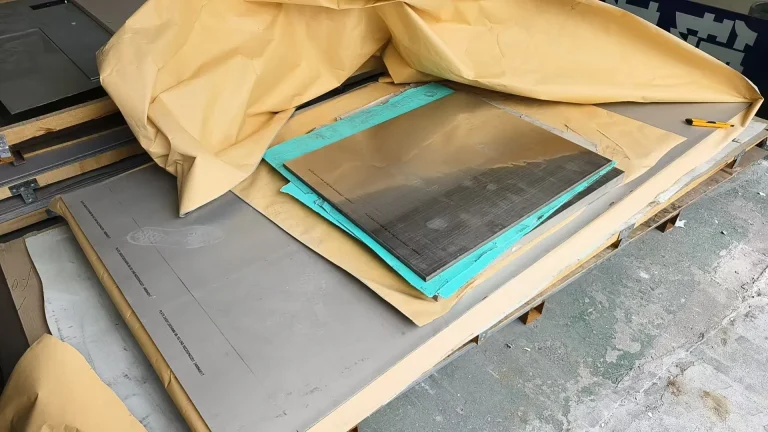
Applications of Invar 36 Plate
- Composite Tooling
- Satellite Frames
- Mirror Supports
- Radar Housings
- LNG Tanks
- Криогенные трубопроводы
- Turbine Components
- Optical Benches
- Metrology Gauges
- Sensor Frames
- Shadow Masks
- Thermostat Strips
- Lithography Chambers
- Laser Spacers
We offer Invar 36 plates and sheets in thicknesses of 1.0-210.We offer not only листы нержавеющей стали and sheets but also plates made of Hastelloy,Incoloy,Inconel,Monel,and other alloys.Our products comply with ASTM A240,EN 10204,ISO 9001,PED 2014/68/EU ,CE,and other standards.With over a decade of experience in manufacturing and import/export,we are your best wholesaler in China.
Chemical Composition of Invar 36 Plate
| Ni | Fe | Co | Mn | Si | C | Cr | п | S |
|---|---|---|---|---|---|---|---|---|
| 35.0 – 37.0 | Остаток средств | ≤ 0.50 | ≤ 0.60 | ≤ 0.30 | ≤ 0.05 | ≤ 0.25 | ≤ 0,015 | ≤ 0,015 |
Key Technical Insights on Invar 36 Chemical Composition
The Critical "36% Nickel" Threshold
The near-zero thermal expansion property of Invar 36 relies entirely on the precise ratio of Nickel to Iron.If the Nickel content drops to 35% or rises to 37%,the CTE increases sharply.The alloy exhibits a phenomenon called magnetostriction,where the natural thermal contraction of the atomic lattice is precisely canceled out by its magnetic expansion behaviors at room temperature.
Strict Control of Impurities
Carbon must be kept below 0.05%.Excessive carbon can lead to the formation of iron/nickel carbides,causing the plate to experience “aging” effects.
Chromium is heavily restricted because even small additions can alter the magnetic Curie point of the alloy,significantly increasing the thermal expansion rate within the target 0°F to 400°F operating window.
Weldability and Composition Matching
When welding Invar 36 plates,the chemistry of the weld puddle is highly sensitive.Standard stainless steel filler wires cannot be used.Welders must use a proprietary filler metal (often called Invar Filler Metal 36 or CF36) that contains slightly modified levels of manganese and titanium.This specialized chemistry prevents hot-cracking while ensuring the welded joint retains the exact same ultra-low expansion properties as the rest of the plate.
Invar 36 Plate Standards & Equivalent Designations
| Invar 36 Alloy (Low Expansion) | |||||
|---|---|---|---|---|---|
| Стандарт / Система | Эквивалентное обозначение | Форма продукта | GB (Китай) | GJB (Military) | GOST (Russia) |
| Китайский стандарт | 4J36 (Fe-Ni36) | Plates, Sheets & Strips | GB/T 15018 | GJB 1952A | – |
| Russian / CIS Standard | 36N / 36H (36Н) | Bars & Rods | GB/T 14985 | – | GOST 14080 / 10994 |
| ISO Chemical Name | Ni36 / FeNi36 | Seamless Pipes & Tubes | – | – | – |
| UNS System | UNS K93600 / K93603 | Welded Pipes & Tubes | – | – | – |
| Aviation / Aerospace | ASTM F1684 / Werkstoff 1.3912 | Forgings & Rings | – | – | – |
| UK Designation | NILO Alloy 36 / Pernifer 36 | ||||
| Generic Trade Name | Invar 36, Alloy 36, Invar Steel | ||||
У вас есть требования?
Kaysuns is a professional supplier of Invar 36 Plates.Please feel free to contact me if you have any requirements.
Свяжитесь с нами для получения дополнительной информации
Mechanical Properties of Invar 36 Plate
The values below represent typical mechanical properties for Invar 36 plates at room temperature (70°F / 21°C),compliant with standards like ASTM F1684 and UNS K93600.
| Имущество | Metric Units | Imperial Units |
|---|---|---|
| Предел прочности | 490 – 550 MPa | 71,000 – 80,000 psi |
| Предел текучести | 240 – 310 MPa | 35,000 – 45,000 psi |
| Elongation at Break | 30 – 40 % | 30 – 40 % |
| Сокращение площади | 60 – 70 % | 60 – 70 % |
| Твердость | 140 – 160 HBW (75 – 85 HRB) | 140 – 160 HBW (75 – 85 HRB) |
| Модуль упругости | 141 – 148 GPa | 20.5 × 10⁶ psi |
| Charpy V-Notch Impact Strength | 135 – 150 J | 100 – 110 ft-lbs |
Key Technical Insights on Invar 36 Mechanical Behavior
Ductility and Austenitic Structure
Mechanically,Invar 36 behaves very similarly to 300-series austenitic stainless steels (like 304 or 316).Because of its face-centered cubic crystal structure,it remains highly ductile and malleable.This high ductility is reflected in its high elongation rate,meaning it will stretch significantly under extreme load before actually snapping.
Modulus of Elasticity Variance
Unlike standard structural steels which have a rigid Young’s Modulus of around 200 GPa,Invar 36 has a notably lower Modulus of Elasticity. This means Invar 36 is more flexible and will deflect or bend more under a mechanical load than standard steel of the same thickness.Engineers must account for this lower rigidity when designing large aerospace tooling structures or load-bearing plates.
Cryogenic Toughness
Most carbon steels and ferritic metals become extremely brittle and crack like glass when exposed to cryogenic temperatures (such as liquid nitrogen at -320°F / -196°C or LNG at -260°F / -163°C).
- Invar 36 plate does not have a ductile-to-brittle transition temperature.
- As the temperature drops into cryogenic zones,its tensile strength and yield strength actually increase while it successfully retains its high impact toughness.This makes it structurally safe for deep-space and liquid gas containment.
The Impact of Cold Working VS. Annealing
The mechanical properties of an Invar 36 plate are highly dependent on its heat-treated state:
- Annealed State:
Offers the lowest yield strength,highest ductility,and the most stable,lowest thermal expansion coefficient. - Cold-Worked (Rolled) State:
If the plate undergoes cold rolling,its yield strength can double and hardness increases.However,cold working introduces internal stress which degrades its low-expansion properties.To restore the near-zero CTE,the plate must undergo a stress-relief anneal.
Our Advantages in Manufacturing Invar 36 Plate
Ultra-Low CTE
We utilize advanced vacuum induction melting coupled with electroslag remelting.This dual-refining process allows us to control the nickel content to a strict tolerance of ±0.1%,guaranteeing a near-zero coefficient of thermal expansion that remains perfectly stable between cryogenic temperatures and 400°F (204°C).
High Structural Purity
By aggressively minimizing trace impurities,we keep carbon levels under 0.02% and restrict sulfur and phosphorus to negligible amounts.This superior chemical cleanliness eliminates internal micro-voids,prevents age-hardening dimensional drift,and drastically reduces the risk of micro-cracking during deep-cut machining operations.
Stress-Relief Uniformity
Internal residual stresses from rolling can compromise dimensional stability when you cut or weld the plate.Our facility implements a proprietary,multi-stage thermal stabilization and stress-relief annealing cycle,ensuring that every plate remains perfectly flat and distortion-free during waterjet cutting, milling,or welding.
Superior Cryogenic Integrity
Thanks to precise grain-size refinement during our hot-rolling phase, our plates maintain an isotropic,fully austenitic microstructure.This ensures the material exhibits exceptional fracture toughness and high Charpy V-notch impact strength at liquid nitrogen (-320°F) and liquid helium temperatures, without experiencing any ductile-to-brittle transition.
FAQs About Invar 36 Plate
Invar 36 exhibits a quantum-mechanical phenomenon called magnetostriction.As temperature rises,atoms naturally try to vibrate further apart (thermal expansion).However,at the same time, the alloy undergoes microscopic magnetic volume changes that pull the atoms back together.In the range of -250°F to 400°F (-157°C to 204°C),these two opposing forces almost perfectly cancel each other out.
Yes,at room temperature.Invar 36 is ferromagnetic.However,it loses its magnetism entirely when heated above its Curie temperature,which is approximately 535°F (279°C).
It has slightly better corrosion resistance than basic carbon steel due to its high nickel content,but it is not stainless steel.It will rust if exposed to moisture,humidity,or corrosive outdoor environments.To prevent oxidation,plates should be kept oiled,stored in climate-controlled environments,or coated.
While plasma or laser cutting is possible,waterjet cutting is highly preferred for Invar 36 plates.Thermal cutting methods (laser, plasma, flame) create massive localized heat-affected zones.This heat distorts the metal and destroys its low-expansion properties near the edge,requiring extensive post-cut machining or stress-relief heat treatment.
Yes,exceptionally well.Unlike carbon steels which become brittle like glass at low temperatures,Invar 36 maintains its face-centered cubic structure.As temperatures drop toward absolute zero,its tensile strength actually increases while its impact toughness and ductility remain safely intact.
Once Invar 36 passes its Curie point (~535°F),its unique magnetic contraction properties disappear.Beyond this temperature,it begins expanding rapidly—at a rate similar to standard carbon steel.For higher temperature ranges,alternative alloys like Invar 42 or specialized superalloys must be used.
Связаться с нами
Свяжитесь с нами
- RM901 No.22 Tangjiaqiao Road Wenzhou Китай
- +86 577 8551 1171
- [email protected]
- https://www.kaysuns.com/
Найти нас