Оглавление
A drawing that specifies 254 SMO in the material column and only the words “solution annealed” in the technical requirements column is not a specification. It does not tell the fabricator the annealing temperature, the cooling medium, the filler metal route or the interpass limit — and those four items decide whether the corrosion resistance paid for in the material column actually arrives at the end of manufacturing.
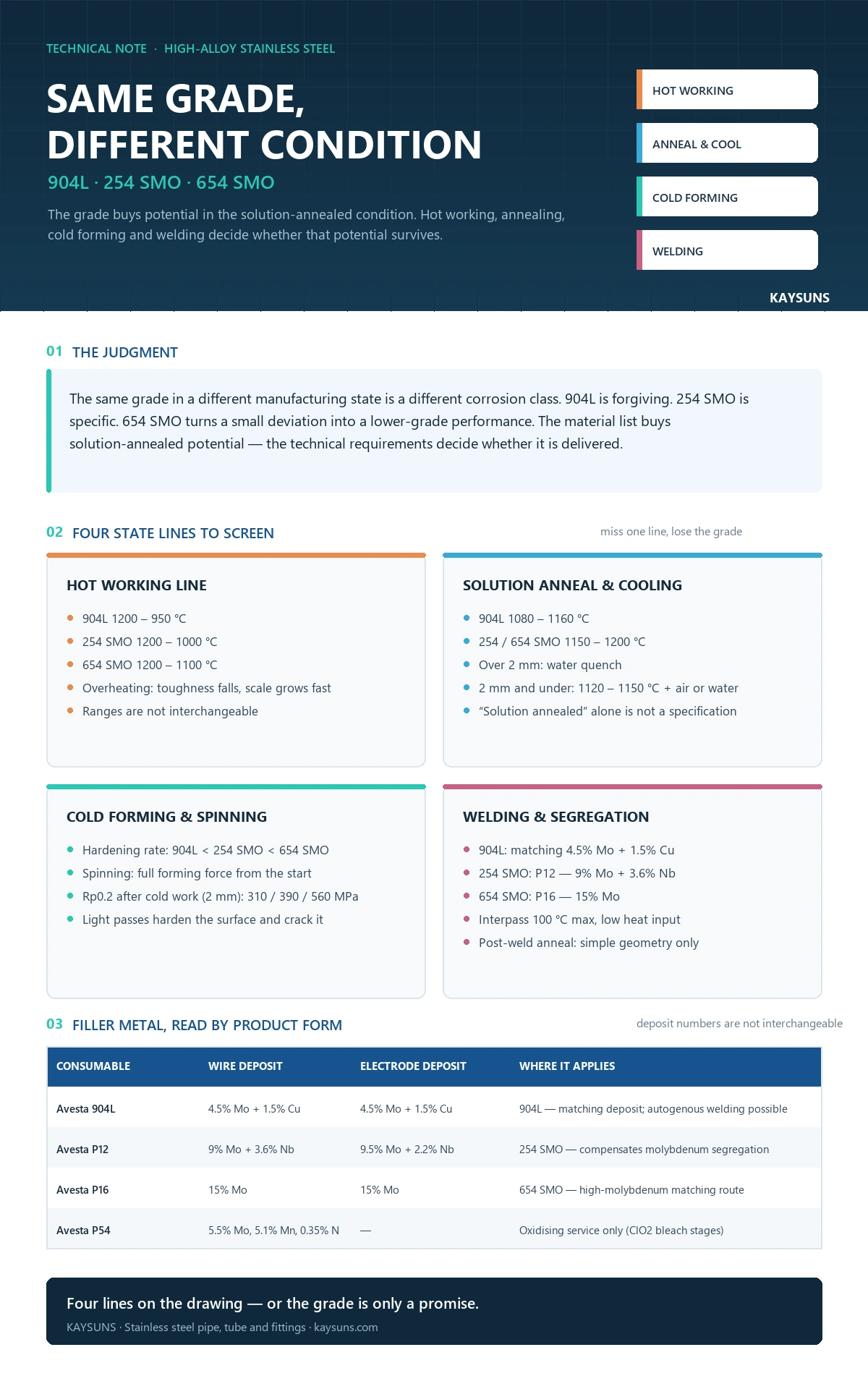
That is the uncomfortable part of working with 904L, 254 SMO and 654 SMO: the grade only buys potential. The manufacturing state — hot working, annealing, cold forming and welding — decides whether that potential is delivered or quietly spent. This article walks through the four state lines for each grade, and shows how to write them into a drawing, a WPS and an inspection record.
The Judgment: Same Grade, Different Corrosion Class
For conventional 304L or 316L, the material column does most of the work. For super austenitic grades it does not. These alloys rely on high molybdenum, nitrogen and nickel content held in a fully austenitic, solution-annealed structure. Disturb that structure and the alloy keeps its name while losing part of its performance.
The evidence is in the mill handbook. 254 SMO and 654 SMO can retain minor amounts of intermetallic phases — chi and sigma — in the core, and these phases also precipitate when the material is exposed to roughly 600–1000 °C. Carrying out the recommended hot working, welding and heat treatment is what makes those precipitates “without harmful effect”. Skip a condition and the precipitates are still there, with corrosion resistance drifting downward.
So the working rule is blunt: the same grade in a different manufacturing state is a different corrosion class. 904L is forgiving of process variation. 254 SMO demands specific parameters. 654 SMO punishes a small deviation by turning a premium grade into mid-grade performance. If you buy these grades for chloride service, the technical requirements column is where the money is either protected or lost.
Hot Working: Three Ranges That Do Not Interchange
The handbook gives a separate hot working window for each grade, and they are not transferable. Working above the window costs toughness and multiplies oxide scale; working below it overloads the press or leaves the material too cold to recrystallise properly.
| Оценка | Hot working range | Finish and cooling |
|---|---|---|
| 904L (N08904) | 1200–950 °C | Finishing above 1100 °C allows direct quenching, only if the whole workpiece is at temperature |
| 254 SMO (S31254) | 1200–1000 °C | Quench from at least 1150 °C after hot working |
| 654 SMO (S32654) | 1200–1100 °C | Quench from at least 1150 °C after hot working |
The 904L exemption has a condition attached
904L carries what looks like a free clause: if hot working stops above 1100 °C, the part can be quenched and used without further heat treatment. In practice the condition attached to that clause is the whole story — the entire workpiece must have reached a sufficiently high temperature.
Local heating, or a part that cools too slowly between operations, does not qualify. In those cases a full solution anneal is mandatory. This is the clause most often half-quoted on the shop floor: the “can be used directly” half gets written down, the “whole workpiece” half does not. Losing the condition is equivalent to losing the rework entitlement that comes with it.
254 SMO and 654 SMO have no such shortcut. Both must be quenched from at least 1150 °C after hot working to avoid residual intermetallic phases. Slow cooling lets those phases re-precipitate, and the corrosion resistance drops with them.
Solution Annealing and the Cooling Line
Annealing temperature and cooling medium belong in the same sentence, because neither works alone.
| Оценка | Solution anneal | Thickness rule |
|---|---|---|
| 904L | 1080–1160 °C | Over 2 mm: water quench. 2 mm and under: anneal at 1120–1150 °C with air or water cooling. |
| 254 SMO | 1150–1200 °C | |
| 654 SMO | 1150–1200 °C |
Two things are easy to lose here. First, the 254 SMO and 654 SMO windows sit roughly 70–100 °C higher than 904L — using a 904L annealing programme on a 254 SMO part leaves it under-annealed. Second, air cooling is only acceptable for thin sections; thicker material needs the water quench to suppress precipitation on the way down — a requirement that is routine on лист нержавеющей стали and heavy-wall бесшовная труба, and is the first process item a mill confirms before quoting.
“Solution annealed” on its own is therefore not a specification. Write the temperature, the cooling medium and the thickness boundary, and require the furnace chart and quench record to prove them.
Cold Forming and Spinning: Hardening Rate Sets the Process
The three grades harden at different rates. 904L behaves close to a conventional austenitic stainless steel. 254 SMO hardens noticeably faster, and 654 SMO faster still. Combine that with a high initial yield strength and the consequences are practical: higher forming loads, and more springback than fabricators expect from 300-series material.
| Оценка | Rp0.2 after cold work, 2 mm | 5 mm | 10 mm |
|---|---|---|---|
| 904L | 310 ± 30 MPa | 290 ± 30 MPa | 290 ± 20 MPa |
| 254 SMO | 390 ± 30 MPa | 380 ± 30 MPa | Not published |
| 654 SMO | 560 MPa | Not published | Not published |
The blank cells matter. Where the mill handbook does not publish a value, that is a data boundary, not an invitation to interpolate. If a design needs a 10 mm 254 SMO formed part with a guaranteed yield strength, the answer is a test, not an extrapolated number.
The counter-intuitive spinning rule
Spinning heads with these grades has one trap that experienced operators still fall into. The handbook requires a sufficiently large forming force from the very first pass, so that the material deforms through its full thickness and flows plastically.
Light, cautious passes feel safer and are worse. Deformation stays near the surface, that surface work-hardens over successive passes, and once the hardened skin exceeds the tensile strength and elongation of the core it cracks. Being gentle with 254 SMO is the fastest route to a scrapped head.
Complex cold forming — particularly where welds are present — may need intermediate annealing, because weld metal and parent metal harden at different rates and have to deform together. The same applies to сварная труба that is subsequently bent or coiled. Process qualification should therefore cover the initial forming-force strategy, not just the final geometry.
Welding: Segregation and the 100 °C Interpass Line
Welding changes the manufacturing state more than any other step. Re-melting redistributes chromium, nickel and especially molybdenum. The as-solidified weld metal keeps that segregation, and the molybdenum-depleted zones are the first to lose local corrosion resistance. A premium parent metal cannot compensate for a wrong filler.
Segregation tendency differs by grade, and so does the compensation route. 904L segregates only mildly and can be welded with a matching consumable — in some cases autogenously. 254 SMO and 654 SMO segregate molybdenum strongly and need a higher-molybdenum filler to compensate. The handbook recommends Avesta P12 for 254 SMO and P16 for 654 SMO.
| Consumable | Wire deposit | Electrode deposit | заявка |
|---|---|---|---|
| Avesta 904L | 4.5% Mo + 1.5% Cu | 4.5% Mo + 1.5% Cu | 904L, matching deposit; autogenous welding possible |
| Avesta P12 | 9% Mo + 3.6% Nb | 9.5% Mo + 2.2% Nb | 254 SMO, compensates molybdenum segregation |
| Avesta P16 | 15% Mo | 15% Mo | 654 SMO, high-molybdenum matching route |
| Avesta P54 | 5.5% Mo, 5.1% Mn, 0.35% N | — | Oxidising service only, such as chlorine dioxide bleach stages |
Read the table by product form. Wire and electrode deposits are not identical — P12 is 9% Mo as wire and 9.5% Mo as electrode — and mixing the two figures in a purchase requisition is an expensive way to buy the wrong consumable. P54 is a special route for oxidising service only; it has no place in a normal chloride-bearing water system.
Three process requirements travel with the filler choice. Keep heat input low, because the fully austenitic structure is sensitive to hot cracking. Let each pass cool to 100 °C before the next one — the same limit applies to all three grades. And put post-weld cleaning, pickling and surface contamination control into the manufacturing documents: weld oxides and embedded carbon steel particles will consume the corrosion margin the parent metal was bought for.
Post-weld solution annealing reduces segregation, but the handbook limits it to simple geometries Такие как арматура, fitting joints and end pieces. On a complex vessel, a full anneal is not a default remedy — it is often impractical and sometimes more damaging than the weld it was meant to fix.
Writing the Condition Into the Design Documents
The phrase “solution annealed” should expand into four groups of clauses in the technical requirements column.
- Forming method and temperature range, including the temperature at which hot working stops.
- Solution annealing temperature, cooling medium and thickness boundary.
- Cold forming scheme: forming-force requirement, whether intermediate annealing is permitted, and post-forming testing.
- Filler metal route (product form and deposit composition), interpass limit of 100 °C, and post-weld surface condition.
Writing “matching filler” in a purchase specification is not enough. The general filler type, the product form, the deposit composition, the heat input, the interpass temperature and the post-weld surface state all need to be traceable in the WPS and in the inspection records.
It also helps to separate the sources of the numbers. The mill handbook gives process recommendations; a code such as GB/T 150.4-2024 gives mandatory requirements. Promoting a handbook recommendation into a mandatory clause oversteps the designer’s authority; omitting a code requirement from the list is a straightforward failure. The technical requirements column should state which is which.
One more caution: the handbook’s design temperature table lists –60 to 400 °C for 904L and 254 SMO, and leaves the 654 SMO cell blank. A blank is not a default value. Projects using 654 SMO must verify the temperature envelope against the actual material route rather than filling the gap by assumption. For wet H2S service, add an ISO 15156-3:2020 cracking assessment; uniform and local corrosion are separate evaluations.
Three Traps and a One-Page Checklist
Trap one: quoting half of the 904L exemption. “May be quenched directly after hot working above 1100 °C” only holds when the whole workpiece reached temperature. Local heating or slow cooling requires a full anneal, and dropping that condition drops the rework entitlement with it.
Trap two: spinning too gently. Insufficient forming force hardens the surface first, and the part cracks after a few passes. The initial forming-force strategy belongs in the process qualification, not only the final dimensional check.
Trap three: a grade without a state. 254 SMO in the material column with no annealing temperature, no cooling medium, no filler route and no interpass limit leaves the inspector with nothing to accept or reject against. The same grade in a different state is a different corrosion class — that sentence belongs in the acceptance criteria, not in a training slide.
The practical version of all this is a one-page screening sheet. Take the drawing and the process card for one high-alloy vessel and tick four lines: hot working temperature, annealing temperature and cooling, cold forming scheme, filler metal and interpass. Whatever is missing gets added. Circle the 1100 °C condition on the 904L line, the 1150 °C quench on the 254 SMO and 654 SMO lines, and the 100 °C interpass limit for all three.
The material column buys solution-annealed potential. The technical requirements column delivers the manufactured condition. Only when all four lines are written into the documents does the grade become the corrosion resistance the vessel was designed around.
ЧАСТО ЗАДАВАЕМЫЕ ВОПРОСЫ
Is 254 SMO the same as 904L in corrosion performance?
Нет. 254 SMO (UNS S31254) carries roughly 6% molybdenum and 0.2% nitrogen, giving it a higher pitting resistance equivalent than 904L (N08904) in most chloride environments. But the gap only holds if the material is correctly annealed and welded. A 254 SMO part processed like 904L can end up performing below its grade.
Why can 904L be quenched directly after hot working but 254 SMO cannot?
904L tolerates a wider cooling path without forming harmful intermetallics, so finishing above 1100 °C allows direct quenching — provided the entire workpiece is at temperature. 254 SMO and 654 SMO precipitate chi and sigma phases more readily and must be quenched from at least 1150 °C after hot working.
Can I use 316L filler metal on 254 SMO?
Not for corrosion-critical service. A 316L deposit is significantly lower in molybdenum than the parent metal and will become the weak point in a chloride environment. 254 SMO is normally welded with a higher-molybdenum consumable such as Avesta P12, and 654 SMO with P16.
What interpass temperature should be specified for these grades?
A maximum of 100 °C between passes, for all three grades, combined with low heat input. Both limits exist to limit segregation and hot cracking in a fully austenitic weld metal.
Does post-weld solution annealing fix a bad weld on a vessel?
It reduces segregation, but the handbook restricts it to simple geometries such as fittings and end pieces. On complex equipment a full anneal is usually impractical and should not be treated as the standard fallback for a poorly controlled welding procedure.
Looking for Super Austenitic Stainless Steel Pipe and Fittings?
KAYSUNS supplies stainless steel and high-alloy pipe, tube and butt-weld fittings for chemical, desalination, pulp and paper, and offshore service, with mill test certificates to EN 10204 3.1 and dimensional inspection reports on request. For 254 SMO heat exchanger bundles we also supply трубка теплообменника, и фланцы из нержавеющей стали in 904L and 254 SMO for vessel and piping work. If your project involves super austenitic grades such as 904L, 254 SMO or 654 SMO, or you need matched Труба из нержавеющей стали 904L, 254 SMO (S31254) pipe а также фитинги под приварку to the same specification, send your size range, schedule and quantity to [email protected], and our team will confirm availability, lead time and the most suitable specification for the application.