ASTM A182 F53 Flange
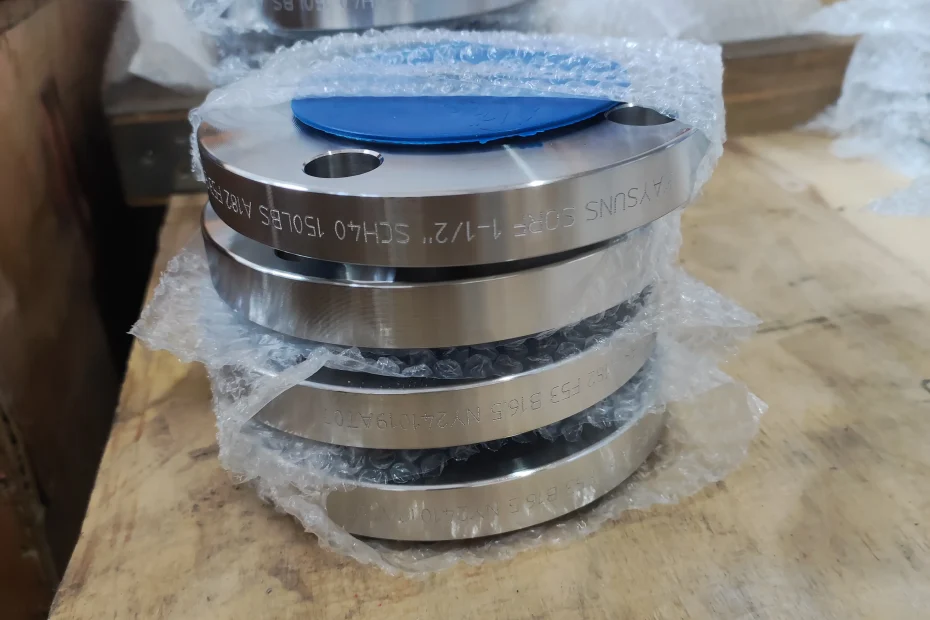
ASTM A182 F53 flange это фланец из нержавеющей стали made from Super Duplex 2507 (UNS S32750 / EN 1.4410). It is engineered for high-pressure piping systems that require extreme mechanical strength and superior resistance to chloride-induced corrosion.
ASTM A182 F53 Flange
The ASTM A182 standard covers forged or rolled alloy steel and stainless steel pipe flanges, forged pipe fittings, and valves intended for use in high-temperature, high-pressure environments.
Grade F53 is a супердуплексная нержавеющая сталь with a chromium content of approximately 25 percent, a nickel content of approximately 7 percent, a molybdenum content of approximately 4 percent, and nitrogen. Its balanced microstructure combines austenitic and ferritic phases, resulting in a yield strength approximately twice that of standard austenitic stainless steels such as 304 or 316.
As a professional flange manufacturer, we know how to work with these materials. F53 forgings must be solution-annealed at a temperature of at least 1880°F (1025°C) and then rapidly water-quenched to achieve optimal corrosion resistance.
Chemical Composition of F53 Flange
| Cr | Ni | Пн | N | Mn | Si | Cu | п | C | S | Fe |
|---|---|---|---|---|---|---|---|---|---|---|
| 24.0 – 26.0 | 6,0 – 8,0 | 3.0 – 5.0 | 0.24 – 0.32 | ≤ 1,20 | ≤ 0,80 | ≤ 0.50 | ≤ 0.035 | ≤ 0.030 | ≤ 0.020 | Остаток средств |
F53 has high chromium, molybdenum, and nitrogen content, and its PREN is greater than 40. This means it meets the “super corrosion-resistant” standard and can provide long-term, stable service in extremely harsh environments—such as high-concentration seawater and acidic conditions—without corrosion.
As long as the carbon content is strictly limited to 0.030% and appropriate heat input and interpass temperatures are maintained, sensitization will not occur in the heat-affected zone of ASTM A182 F53 flanges during the welding process.
У вас есть требования?
Kaysuns is a professional supplier of F53 flange. Please feel free to contact me if you have any requirements.
Свяжитесь с нами для получения дополнительной информации
Mechanical Properties of F53 Flange
ASTM A182 F53 (UNS S32750) flanges deliver a minimum tensile strength of 116 ksi (800 MPa) and a minimum yield strength of 80 ksi (550 MPa) for sections up to 2 inches (50 mm) thick.This material has approximately twice the strength of standard 300-series austenitic stainless steel, while maintaining good ductility.
Per ASTM A182 / A182M requirements, the required mechanical values depend on the section thickness of the forging:
Per ASTM A182 / A182M requirements, the required mechanical values depend on the section thickness of the forging:
| Имущество | Section Thickness ≤ 2 in. (50 mm) | Section Thickness > 2 in. (50 mm) |
|---|---|---|
| Tensile Strength (Minimum) | 116 ksi (800 MPa) | 106 ksi (730 MPa) |
| Yield Strength, 0.2% Offset (Minimum) | 80 ksi (550 MPa) | 75 кси (515 МПа) |
| Elongation in 2 in. or 4D (Minimum) | 15% | 15% |
| Brinell Hardness (Maximum) | 310 HBW | 310 HBW |
Ударная вязкость
While ASTM A182 does not mandate a universal Charpy V-notch value for F53, industry and offshore specifications typically require a minimum impact energy of 40 J to 50 J at -46°C (-50°F) to ensure resistance to brittle fracture in sub-zero environments.
Sour Service Hardness
When ordered to NACE MR0175 / ISO 15156 for hydrogen sulfide (H₂S) environments, hardness is strictly capped at 32 HRC (or ~300–310 HBW) to prevent sulfide stress cracking.
Section Thickness Effect
Thicker forgings (> 50 mm) cool slightly slower during water quenching after solution annealing, which accounts for the slight reduction in minimum guaranteed tensile and yield strengths compared to thinner sections.
Manufacturing Methods for F53 Flange
Closed-Die Forging
Our closed-die forging process involves pressing heated ASTM A182 F53 steel billets into precision dies to produce standard flanges that are close to their final shape. This method is particularly well-suited for high-volume orders of small- to medium-sized parts and ensures a continuous, oriented grain flow in the flanges.
Open-Die Forging
For large-diameter, thick-walled, or custom-designed F53 flanges, we use heavy-duty hydraulic presses for open-die forging. This versatile process refines the internal grain structure and eliminates defects, while meeting the requirements for non-standard dimensions and high-pressure ratings without the need for costly tooling expenses.
Seamless Ring Rolling
We use a seamless ring rolling process to manufacture large-diameter F53 flanges. By rolling open-hole billets between precision rollers, we maximize circumferential strength while minimizing raw material waste, passing these cost savings directly on to you.
Plate Cutting and CNC Machining
When your project requires rapid delivery of flat blind flanges or low-stress structures, we use certified ASTM A240 UNS S32750 solution-annealed steel plates to precision-cut parts directly. We employ high-precision CNC machining that complies with the ASME B16.5 standard for blind flange applications.
Applications of ASTM A182 F53 Flange
- Marine and Shipbuilding Engineering
- Химическая и нефтехимическая обработка
- Заводы по опреснению морской воды
- Subsea Piping and Umbilicals
- Offshore Oil and Gas Platforms
- Hydrometallurgy and Mining
- LNG and Cryogenic Terminals
- Subsea Heat Exchangers and Condensers
- Power Generation and Flue Gas Desulfurization
- Целлюлозно-бумажные отбеливающие заводы
FAQs About ASTM A182 F53 Flange
ASTM A182 F53 is the forging specification for super duplex 2507 stainless steel. Its international equivalents include UNS S32750, EN 1.4410 (X2CrNiMoN25-7-4), and SAF 2507.
F51 flanges are suitable for moderate chloride environments, with a PREN value of approximately 35. F53 flanges have a higher alloy content and are suitable for severe marine and subsea environments. F55 flanges have strength similar to that of F53 flanges, but offer better resistance to sulfuric acid and hydrochloric acid.
The maximum recommended continuous operating temperature for F53 flanges is 600°F (315°C). In cold environments, F53 flanges can operate normally at temperatures as low as -50°F (-46°C).
Yes. We offer ASTM A182 F53 flanges that comply with the NACE MR0175 / ISO 15156 standards and are suitable for acidic environments containing hydrogen sulfide. Our NACE-compliant F53 flanges undergo rigorous solution annealing and rapid water quenching to ensure that the surface hardness remains below the mandatory maximum value of 32 HRC.
We manufacture butt-weld neck flanges, slip-on flanges, blind flanges, socket-weld flanges, threaded flanges, and lap-joint flanges, and offer three connection types: raised face, flat face, and ring-type.
Standard sizes range from ½” to 24” in accordance with ASME B16.5 and from 26” to 60” in accordance with ASME B16.47, with pressure ratings including 150#, 300#, 600#, 900#, 1500#, and 2500#. We also accept custom drawings.
Standard sizes range from ½” to 24” in accordance with ASME B16.5 and from 26” to 60” in accordance with ASME B16.47, with pressure ratings including 150#, 300#, 600#, 900#, 1500#, and 2500#. We also accept custom drawings.
Each shipment is accompanied by a factory test certificate in accordance with EN 10204, Section 3.1, verifying chemical composition, mechanical properties, and heat treatment records for solution annealing.
We also provide 100% PMI, hardness testing, UT, and PT. If required, third-party inspections conducted by SGS, BV, TÜV, DNV, or Lloyd’s Register can be arranged.
We also provide 100% PMI, hardness testing, UT, and PT. If required, third-party inspections conducted by SGS, BV, TÜV, DNV, or Lloyd’s Register can be arranged.
Связаться с нами
Свяжитесь с нами
- RM901 No.22 Tangjiaqiao Road Wenzhou Китай
- +86 577 8551 1171
- [email protected]
- https://www.kaysuns.com/
Найти нас