Qu'il s'agisse de remplacer des joints usés ou d'installer de nouvelles soupapes, la détermination précise de l'état de l'eau est essentielle. taille de la bride Dans le secteur de la tuyauterie industrielle, une erreur de quelques millimètres peut entraîner des défaillances catastrophiques. brides en acier inoxydable.
L'importance d'une mesure précise
Avant de commencer, il faut savoir que la taille d'une bride ne se limite pas à son diamètre extérieur, mais qu'elle implique un ensemble de dimensions spécifiques qui doivent être conformes aux normes internationales, telles que ASME B16.5 ou EN 1092-1.Si vous calculez mal la taille, les trous des boulons ne seront pas alignés. Par conséquent, le joint ne se mettra pas en place correctement, ce qui entraînera une répartition inégale de la pression et, finalement, une défaillance de l'articulation.
Ce que nous faisons
- Plaque
- Feuille
- Forgeage
- Barre ronde
- Bride
- Tuyaux
- Raccords
- Sur mesure
Contactez-nous pour plus d'informations
Corrélation entre la taille de la bride et la classe de pression
Par exemple, une bride de 2 pouces de classe 150 a un cercle de boulons différent de celui d'une bride de 2 pouces de classe 600.
Lorsque la pression nominale augmente, la bride devient plus épaisse pour supporter une contrainte interne plus élevée. En outre, les trous de boulons deviennent souvent plus grands ou plus nombreux pour fournir une plus grande force de serrage. Par conséquent, si vous ne mesurez que l'alésage, vous risquez de commander un composant qui ne s'adapte pas à vos raccords de tuyauterie en acier inoxydable existants. Vérifiez toujours la “classe” ou le “PN” avant de finaliser vos mesures.
Outils essentiels pour mesurer la taille des brides
- Pieds à coulisse :
Idéal pour mesurer l'épaisseur et les petits diamètres. - Grands étriers extérieurs :
Nécessaire pour mesurer le diamètre extérieur total des grandes brides. - Jauge de trou de boulon :
Permet de déterminer le diamètre exact des trous. - Tableau des mesures :
Utilisé pour croiser vos résultats avec des tableaux de taille standard.
Guide de mesure de la bride étape par étape
Pour trouver la taille correcte de la bride, suivez cette séquence spécifique.Enregistrez toujours vos mesures en millimètres et en pouces pour éviter les erreurs de conversion.
Mesurer le diamètre extérieur (OD)
Commencez par mesurer la distance sur toute la surface de la bride.Placez vos pieds à coulisse aux points les plus larges du cercle extérieur.Cette mesure permet de réduire la catégorie de taille potentielle mais ne définit pas la pression nominale.
Déterminer le diamètre du cercle du boulon (BCD)
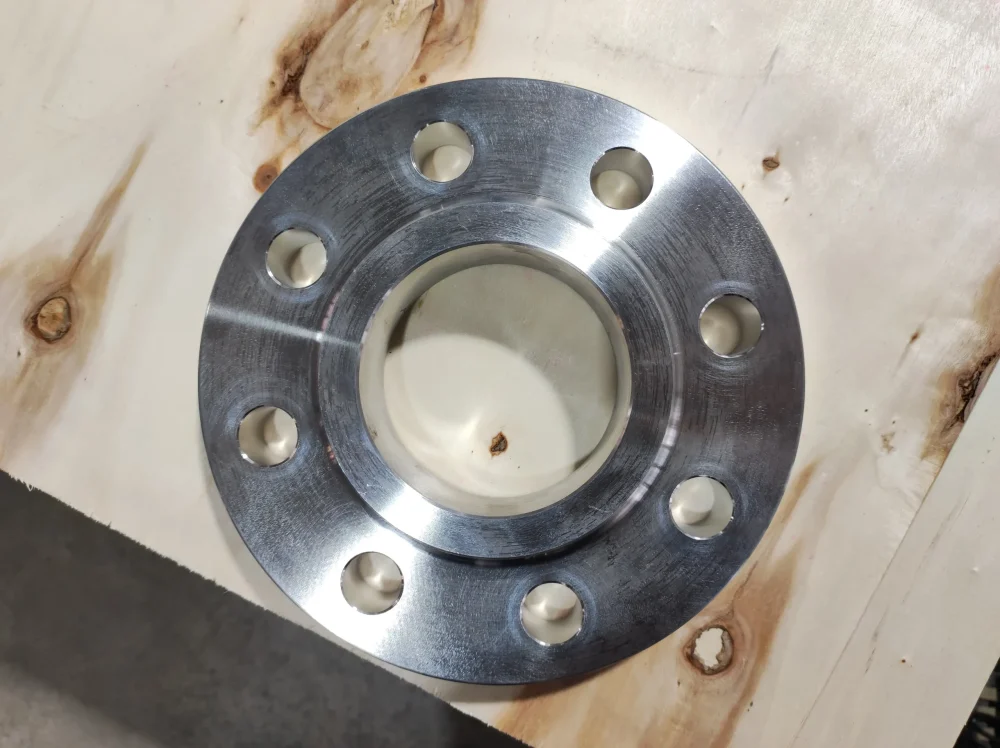
Mesurez à partir du centre d'un trou de boulon jusqu'au centre du trou opposé. Si vous ne pouvez pas atteindre le centre, mesurez à partir du bord intérieur d'un trou jusqu'au bord extérieur du trou opposé.
Compter le nombre de trous de boulons
Les brides standard ont généralement des trous par multiples de quatre (4, 8, 12, 16, etc.). La combinaison du BCD et du nombre de trous indique généralement la classe de pression (par exemple, classe 150 ou classe 300).
Mesurer la taille de l'alésage (ID)
L'alésage correspond au diamètre intérieur de la bride. Il doit correspondre au diamètre nominal du tube en acier inoxydable que vous utilisez. Par exemple, un tube de 2 pouces nécessite une bride avec un alésage de 2 pouces.
Vérifier l'épaisseur
Mesurez l'épaisseur de la bride au niveau du bord. Les brides plus épaisses indiquent généralement une pression nominale plus élevée.
Vérification professionnelle : Lecture des marquages de brides
Les experts ne se fient pas uniquement aux pieds à coulisse pour déterminer les dimensions des brides. Chaque bride en acier inoxydable de première qualité comporte des marques gravées sur son bord extérieur.
- Taille:
Recherchez un marquage tel que “2” ou “DN50”.” - Evaluation :
Vous verrez “150#”, “CL150” ou “PN16”.” - Matériau :
Il indique souvent la qualité, par exemple “316L”.” - Standard:
Recherchez des codes tels que “B16.5” ou “EN1092-1”.”
Tableau de référence des dimensions des brides (ASME B16.5 Classe 150)
| Taille nominale du tuyau (NPS) | Diamètre extérieur (OD) | Diamètre du cercle de boulon (BCD) | Nombre de trous | Diamètre du trou |
|---|---|---|---|---|
| 1/2 po | 3.50″ (89mm) | 2.38″ (60mm) | 4 | 0,62″ (16mm) |
| 1 pouce | 4.25″ (108mm) | 3.12″ (79mm) | ||
| 2 pouces | 6.00″ (152mm) | 4.75″ (121mm) | 0.75″ (19mm) | |
| 4 pouces | 9.00″ (229mm) | 7.50″ (190mm) | 8 | |
| 6 pouces | 11.00″ (279mm) | 9.50″ (241mm) | 0.88″ (22mm) |
Conversion internationale : NPS vs. DN
Si votre projet implique des équipements provenant de différentes régions, vous pouvez rencontrer différents systèmes de dimensionnement. Les États-Unis utilisent le NPS (Nominal Pipe Size), tandis que l'Europe utilise le DN (Diameter Nominal).
| NPS (impérial) | DN (métrique) | Correspondance des mesures ? |
|---|---|---|
| 2 pouces | DN50 | Presque identiques ; vérifier l'espacement des trous |
| 4 pouces | DN100 | Point de croisement commun |
| 8 pouces | DN200 | Les différences majeures dans les modèles de boulons commencent |
Identification du type de face de bride
La forme de la face de la bride a également un impact sur la façon dont vous mesurez la taille de la bride. Vous devez identifier si la bride est une “face plate” (FF), une ”face surélevée” (RF) ou un “joint de type anneau” (RTJ).
- Face surélevée (RF) :
Ils présentent une petite section surélevée autour de l'alésage. Vous devez mesurer le diamètre de cette section surélevée séparément. - Joint de type anneau (RTJ) :
Vous devez mesurer la largeur et la profondeur de la rainure pour sélectionner le joint métallique adéquat.
Dépannage des erreurs de mesure
Si la taille de votre bride ne correspond à aucun tableau standard, envisagez les possibilités suivantes.Tout d'abord, vérifiez si la bride est métrique (DIN/EN) plutôt qu'impériale (ASME).Les brides européennes utilisent des espacements et des diamètres de trous différents.Ensuite, inspectez la bride pour voir s'il n'y a pas de couche passive ou de revêtement qui pourrait ajouter une légère épaisseur.Enfin, assurez-vous que la bride n'est pas déformée.Une bride déformée donnera des lectures de diamètre incohérentes sur les différents axes.
| Erreur potentielle | Symptôme | Solution |
|---|---|---|
| Métrique ou impérial | Le BCD est décalé de quelques millimètres | Passer à une carte de référence EN 1092-1 |
| Visage déformé | Le DO varie en différents points | Inspecter la bride pour vérifier qu'elle n'est pas endommagée mécaniquement |
| Interférence des débris | La mesure d'identification semble trop petite | Nettoyer l'alésage de toute trace de calamine ou de scories |
| Mauvaise classe de pression | OD est correct mais BCD est erroné | Vérifier s'il s'agit d'une bride de classe 300 ou 600 |
Nous contacter
Prendre contact
- RM901 No.22 Tangjiaqiao Road Wenzhou Chine
- +86 577 8551 1171
- [email protected]
- https://www.kaysuns.com/
Trouvez-nous